The AI That Remembers How Your Kid Learns
Every homeschool parent is a walking file cabinet. You are the one who knows the borrowing meltdown happened in November, that word problems go better after lunch, that the Minecraft explanation is the only fraction explanation that has ever worked. Bring any tool or tutor into your school and the first job is always the same: re-explain your kid from the beginning. Again.
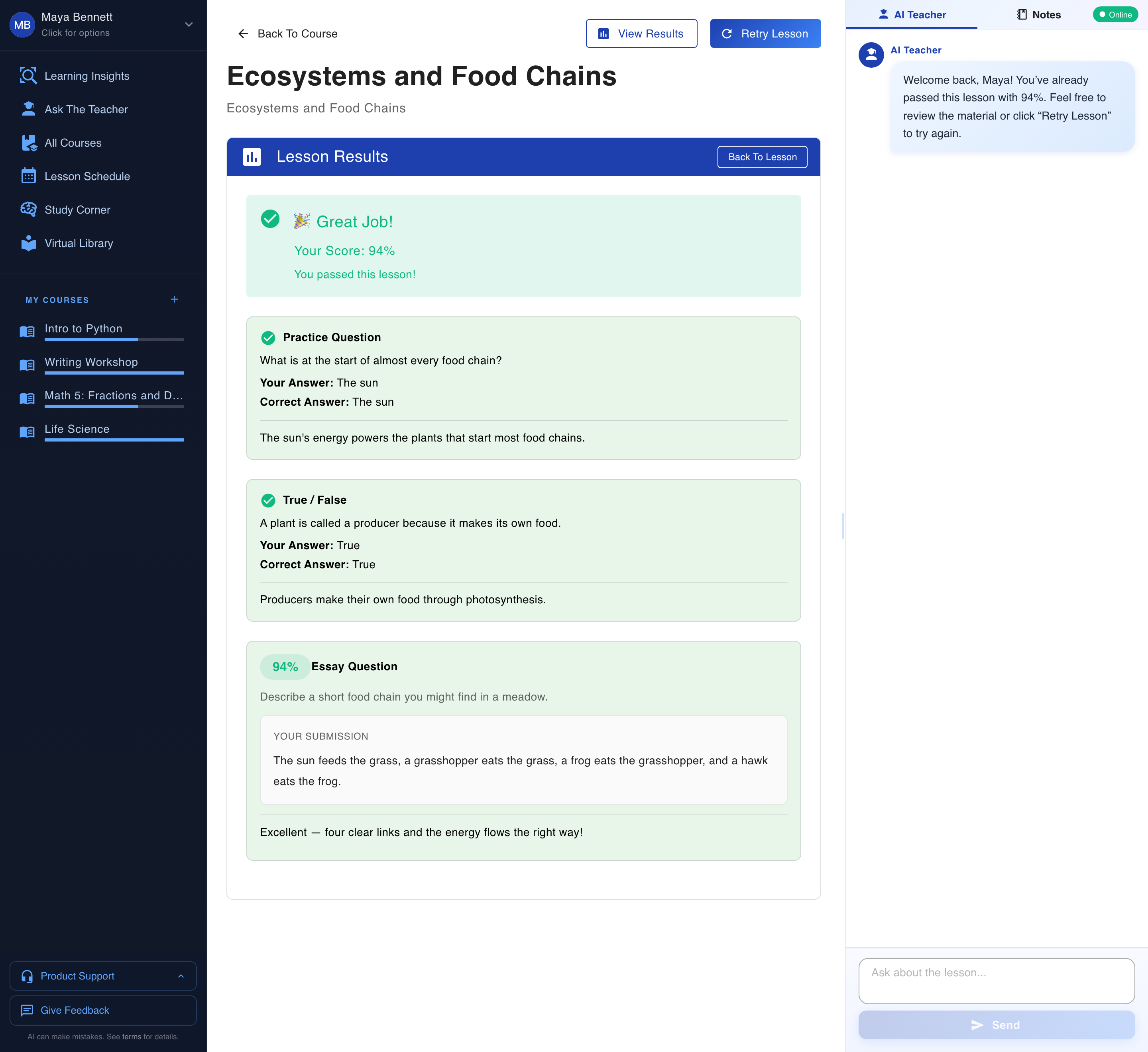
That job is exactly what AI Home Academy's memory system exists to take off you. The AI teacher builds a running memory of your specific child, automatically, from their actual lessons. What they have mastered, where they struggle, which analogies land, what they love, and the goals you set. Every session starts from that record instead of from zero. A generic chatbot forgets your child the second the tab closes. This one comes back knowing them.
I will say the opinionated version plainly: memory is the entire difference between an AI toy and an AI teacher. Everything else is presentation.
What makes an AI teacher different from a chatbot?
A chatbot answers whatever you type, then forgets you. It has no idea your daughter melts down at word problems, or that basketball is the only thing keeping her at the table. An AI teacher carries that forward. It builds a running memory of your specific child and uses it to shape what comes next. Same underlying intelligence, completely different relationship.
Think about why a great human tutor is worth the money. Credentials are the smallest part of it. After a few months, a good tutor knows your kid: the analogy that clicked, the subject that makes your child freeze, the small win they were proud of for a week. They stop teaching a generic student and start teaching yours.
A blank chatbot can never get there. You can type a brilliant prompt and get a brilliant answer, but tomorrow you are strangers again. There is no thread connecting this session to the last one, so the thread stays where it has always been. In your head. Which means the work you hoped to hand off never left.
What does it remember about your kid?
It keeps a running record of the things a good tutor would hold in their head, five kinds of memory tied to one child:
- Lesson summaries. What was covered and how it went, written down after every lesson.
- Struggles. The concepts your child genuinely fought with, kept present until they are fixed.
- Wins. The breakthroughs, so future lessons can build on proof instead of hope.
- Interests. Basketball, dinosaurs, Minecraft, whatever they mention in passing that makes examples land.
- Goals. The targets you set, like reading at grade level by spring, so lessons push toward what you care about.
Here is what that looks like in a real week. A lesson wraps, and the platform writes a short summary of what happened. Your kid hit a wall on borrowing in subtraction, so that gets recorded as a real struggle rather than a passing stumble. Two lessons later they finally nail it, and the win gets recorded too. Somewhere in between, your son mentions he is obsessed with soccer. That sticks, and next month a percentage problem is suddenly about shooting accuracy.
Notice what is missing from that story: you. There is no profile builder, no tagging, no settings page to maintain. The memory assembles itself out of the lessons, which I consider a design requirement rather than a convenience. Any system that asks a tired parent to hand-enter their child's learning history ends up empty within two weeks, and an empty memory helps nobody.
How does the memory stay useful instead of drowning in trivia?
It is weighted. A stubborn struggle or a hard-won win stays front and center, while smaller details wait in the background until they are relevant. If every stray comment carried equal importance, the memory would be noise within a week. The things that shape learning stay loud. The favorite-snack asides stay quiet until an example needs them.
That mirrors how you remember your own kid. You do not consciously recall every sentence they have said this year. But you never forget the subject that reduces them to tears, or the day something finally clicked. Important stuff lives up top. The rest is there when you reach for it.
How does memory change the next lesson?
The next time your child sits down, the AI teacher already knows what they have mastered, where they wobble, and which examples land. So it skips what they already own. It avoids the analogy that flopped last time. It builds on last week's win instead of rediscovering it. Each session starts a step ahead, and those steps compound across a school year.
Say your daughter finally understood fractions through Minecraft blocks. Next time fractions come up, the teacher reaches for blocks again, not a fresh metaphor she has to decode cold. Say your son shuts down when a lesson opens with a wall of text. The teacher remembers, and it comes at the topic through a different door.
The underrated half is what the teacher stops doing. Re-explaining something a kid already owns is never neutral. It bores them, it signals that nobody is paying attention, and it burns the small ration of patience they brought to the table. Repeating a metaphor that already confused them is worse. Memory spares your child both, and that quiet mercy is often the real reason a kid stays engaged with this when every other app got abandoned by week three.
You can watch it happen inside a lesson. The teacher references something from before, a concept already covered or an interest mentioned once, and the reply lands like it came from someone who knows them. Kids notice being known. Adults do too.
Is this what "personalized learning" was supposed to mean?
Yes, and I understand if the phrase has lost your trust. Most tools that advertise personalization are picking easier or harder questions from a bank, which personalizes difficulty and nothing else. Memory personalizes the teaching itself: the explanations, the examples, the pacing, and what gets revisited. One is a settings knob. The other is the thing you actually wanted when you first read the word.
The memory also refuses to stay siloed, which matters more than any single feature. The same picture of your child that tells the teacher which analogy to use also tells the Max AI plan's Study Corner where the gaps are and how to fix them. Gaps, wins, and preferences flow into one shared record, and every part of the platform teaches from it.
| Generic AI chatbot | AI teacher with memory | |
|---|---|---|
| Start of each session | From zero, no history | From what your kid already knows |
| Struggles | Forgotten when you close it | Held onto and worked on until fixed |
| Analogies | May repeat one that failed | Reuses what clicked, drops what did not |
| Preferences | Not stored | Remembered from a passing mention |
| Over time | Same tool, every day | Sharper about your child, every day |
The memory does the remembering, and the teacher persona your child picks sets the tone. Together they add up to something that feels less like software and more like a tutor who has been with your child a while.
To be clear about the limits: none of this makes the AI a human, and it is not auditioning to replace you at the kitchen table. What it carries is the thread, the accumulated who-is-this-kid knowledge you would otherwise hold alone, so your energy goes to teaching the child in front of you instead of rebuilding their history every morning.
Let it learn your kid for a week
A tool that forgets your child every session is a search box with better manners. A teacher that remembers is a different category of help. It knows what your kid has mastered, where they wobble, and which example made it stick, and it brings all of that to the next lesson without being asked. The file cabinet finally gets to be software instead of you.
If you want to see it happen, start a free trial. It runs on the full Max tier, so the memory system is live from the first lesson. Give it a handful of honest sessions, then watch for the moment the teacher references something your child did last week. That moment is the product.