The Learning Gap You Never Noticed, Already Being Fixed
Somewhere around week three of fractions, a couple of problems go wrong and nobody thinks twice. The lesson score looked fine. The week felt fine. Then months later your child stares at a division problem like it is written in a language they have never seen, and the night ends with a closed notebook and somebody near tears. None of that is a parenting miss. A learning gap is invisible while it forms. It only makes noise after it has been compounding for a while, and by then the original crack is buried under everything built on top of it.
That failure mode bothered me enough that I built our platform around it, so here is the direct answer up front. After every graded lesson, AI Home Academy reads back through your child's actual answers. Any concept scored under 70 percent gets flagged as a learning gap, and on the Max AI plan your child can open a Study Corner session on it, a focused practice space built around that single shaky skill. One tap starts a session that rebuilds it while the fix still takes an afternoon instead of a semester.
What happens the moment your kid gets something wrong?
The lesson gets graded, and then the platform reads every answer looking for weak concepts rather than stopping at a score. Anything under 70 percent on a specific concept becomes a named learning gap automatically, ready for a Study Corner session on the Max AI plan. No alarm goes off and nothing new lands on your plate. The catch happens quietly, while the gap is still one afternoon wide.
Most learning tools stop at the grade. They tell you the lesson was 82 percent and leave you to guess which 18 percent went sideways, and whether it matters. I have a strong opinion here: a grade with no follow-through is trivia. On our platform the wrong answers get treated as evidence. Each weak concept gets pulled out by name, so "82 percent in math" becomes "equivalent fractions are wobbly, everything else is solid."
That naming step sounds small. It is the difference between worrying about math in general and fixing one specific thing this week.
How does it tell a real learning gap from a bad morning?
It measures how deep the gap runs instead of treating every miss the same. Each flagged concept gets a mastery level based on how much your child got right. Under 40 percent correct is Struggling. From 40 to 59 is Developing. From 60 to 69 is Approaching, close but not solid. That rating decides how much rebuilding the concept gets, so a near-miss and a real breakdown are never handled the same way.
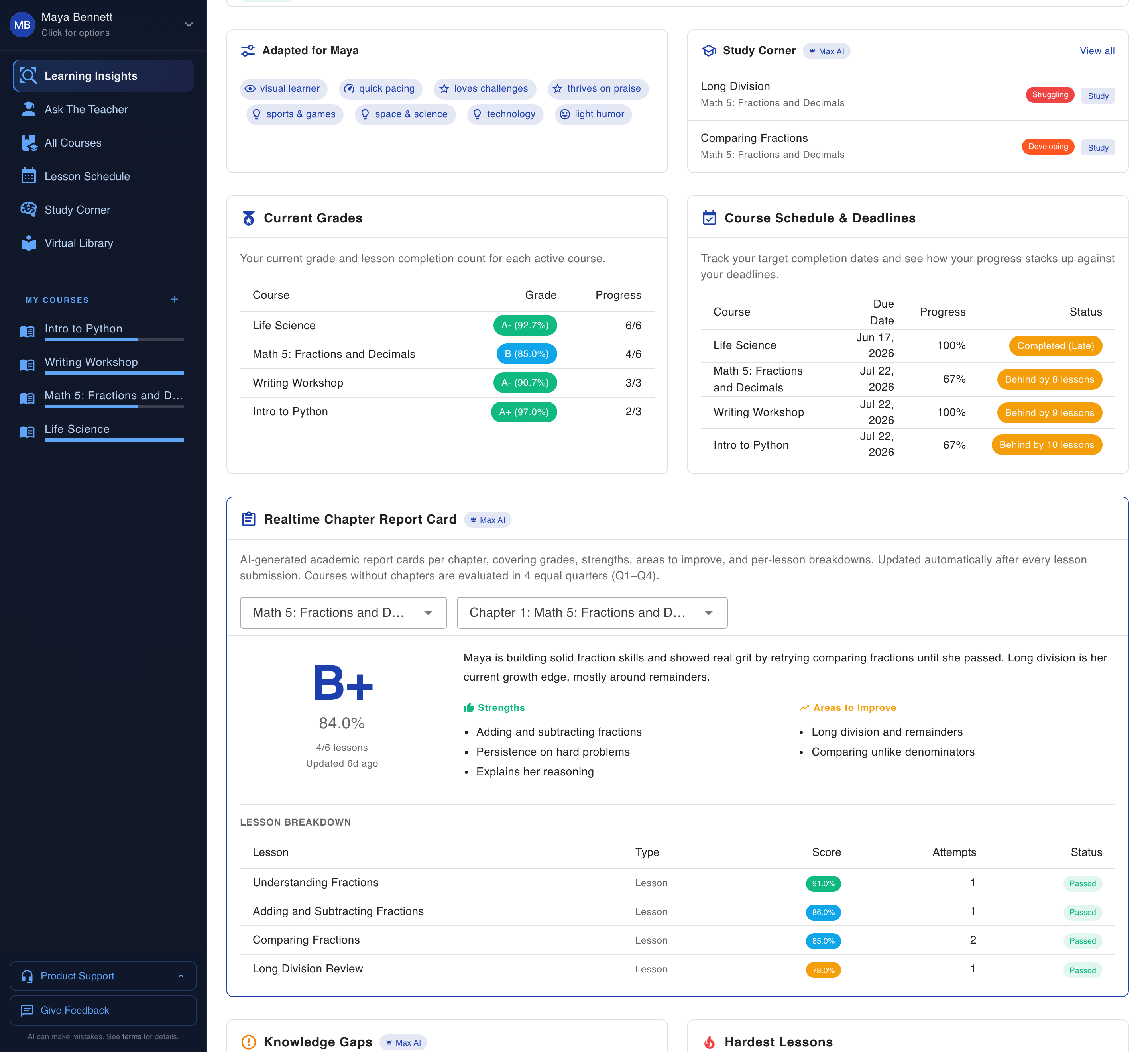
The distinction earns its keep fast. A kid who is Approaching on borrowing in subtraction needs a nudge and a few reps. A kid who is Struggling with it needs the idea taught again from the ground up, because piling practice questions onto a misunderstanding teaches them to hate subtraction. Generic review lumps those two kids together. The badge tells you, at a glance, which one is sitting at your table.
| Mastery level | Percent correct | What it usually means |
|---|---|---|
| Struggling | Under 40% | The concept did not land; teach it fresh |
| Developing | 40 to 59% | Partial grasp with real holes to fill |
| Approaching | 60 to 69% | Close, needs targeted practice to lock in |
And if the miss was a fluke, a distracted morning, a misread question, the gap closes itself almost immediately. Your child clears the bar on the next attempts and the concept gets logged as mastered without ceremony. A bad morning costs a few extra practice questions. It never becomes a label.
What actually happens inside a study session?
You or your child taps the gap, and in about a minute the platform builds a fresh session around that one skill. It runs four activities in a fixed order. Re-Explain teaches the concept from a new angle. Walkthrough shows a worked example step by step. Drill serves five to eight practice questions aimed at the exact weak spot. Flashcards lock in the key terms. Understand it, watch it, do it, remember it.
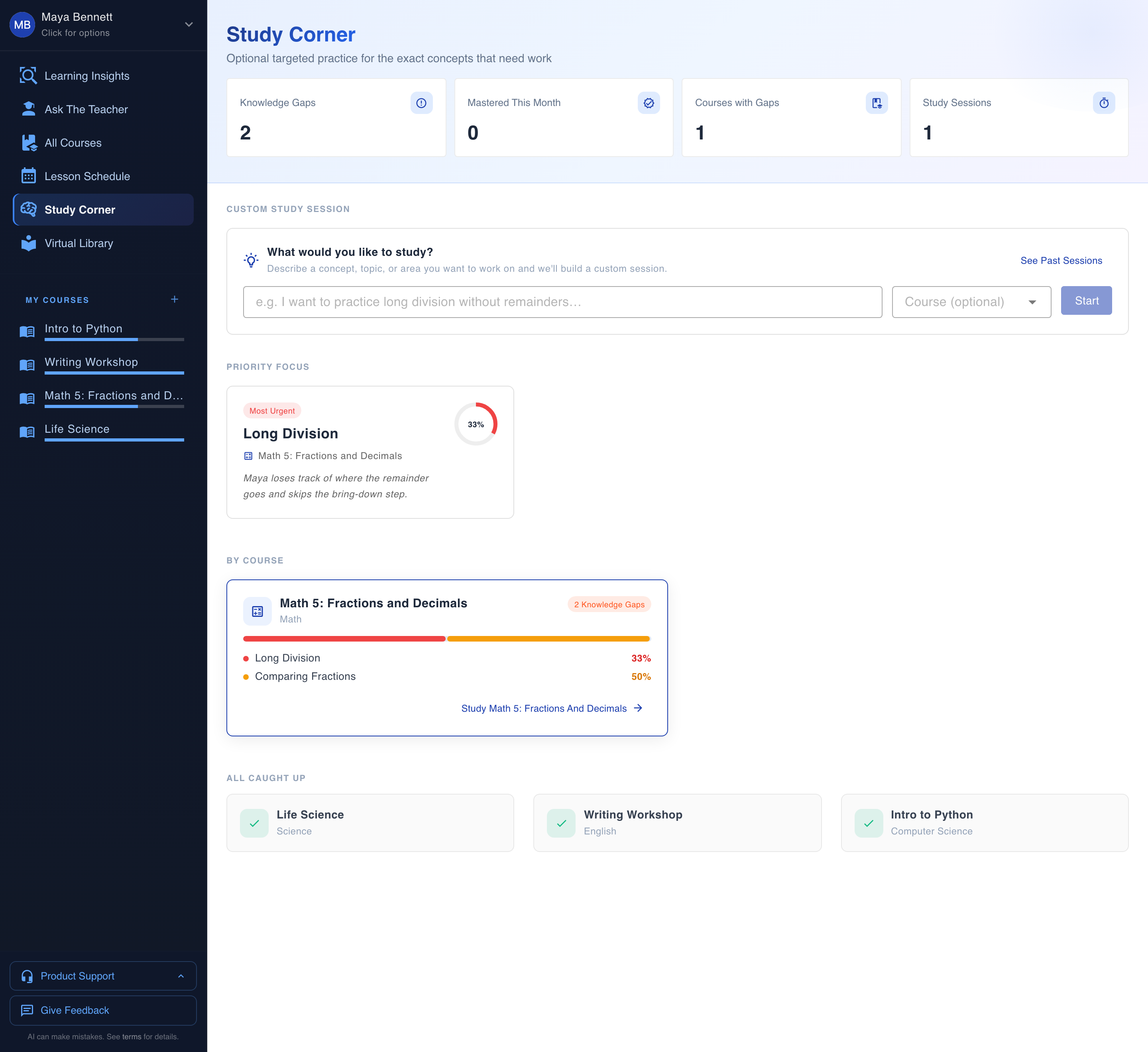
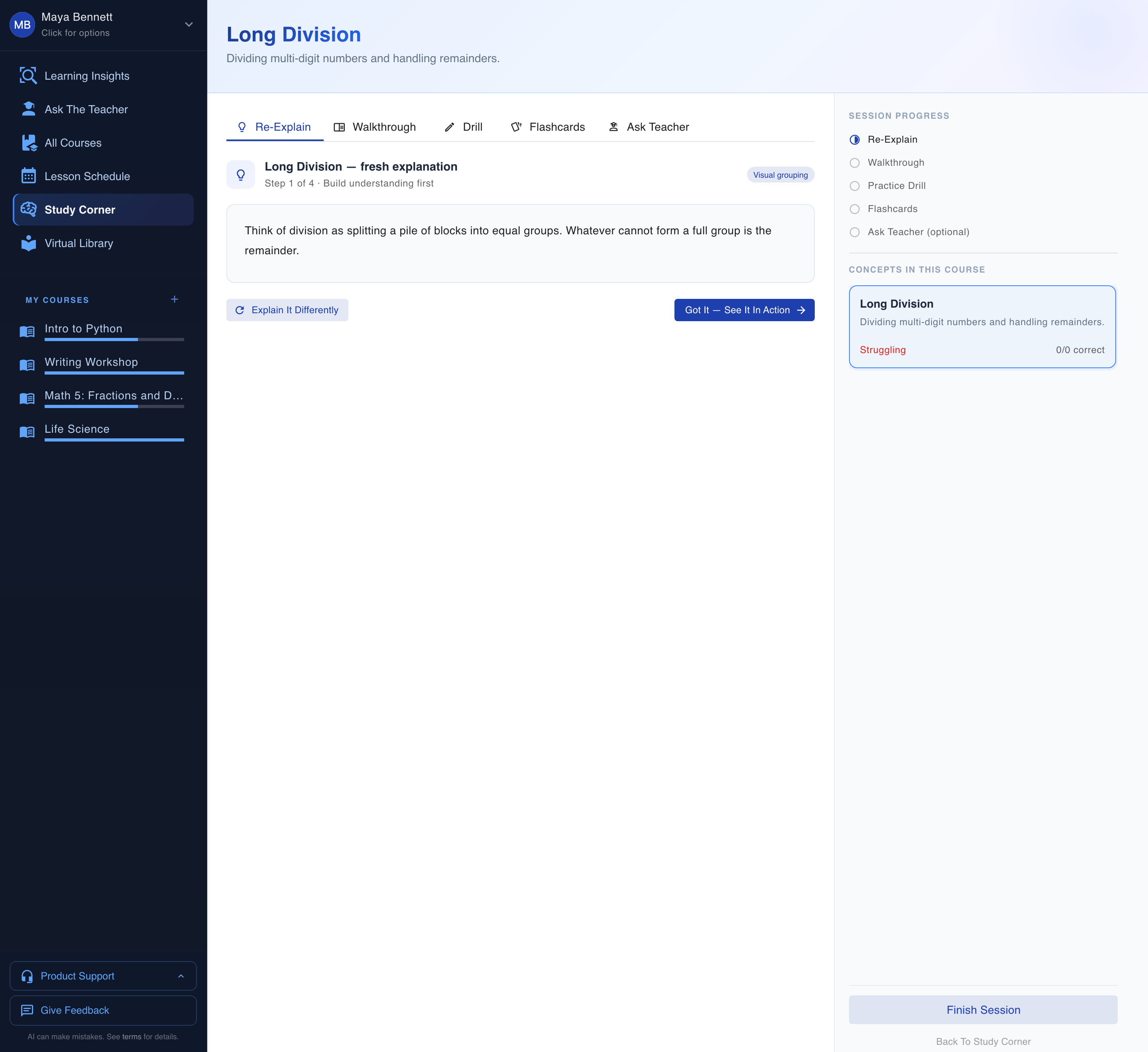
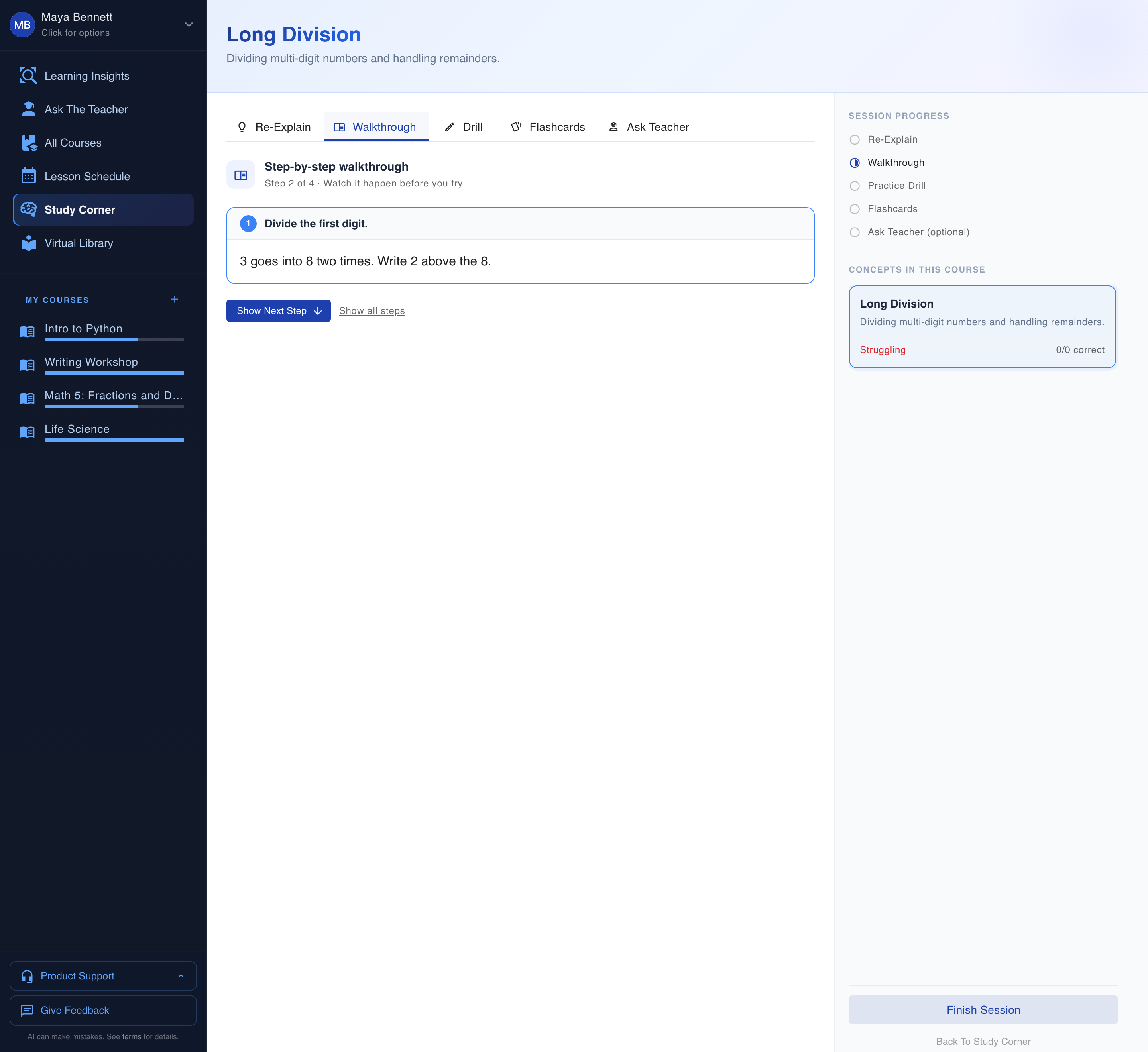
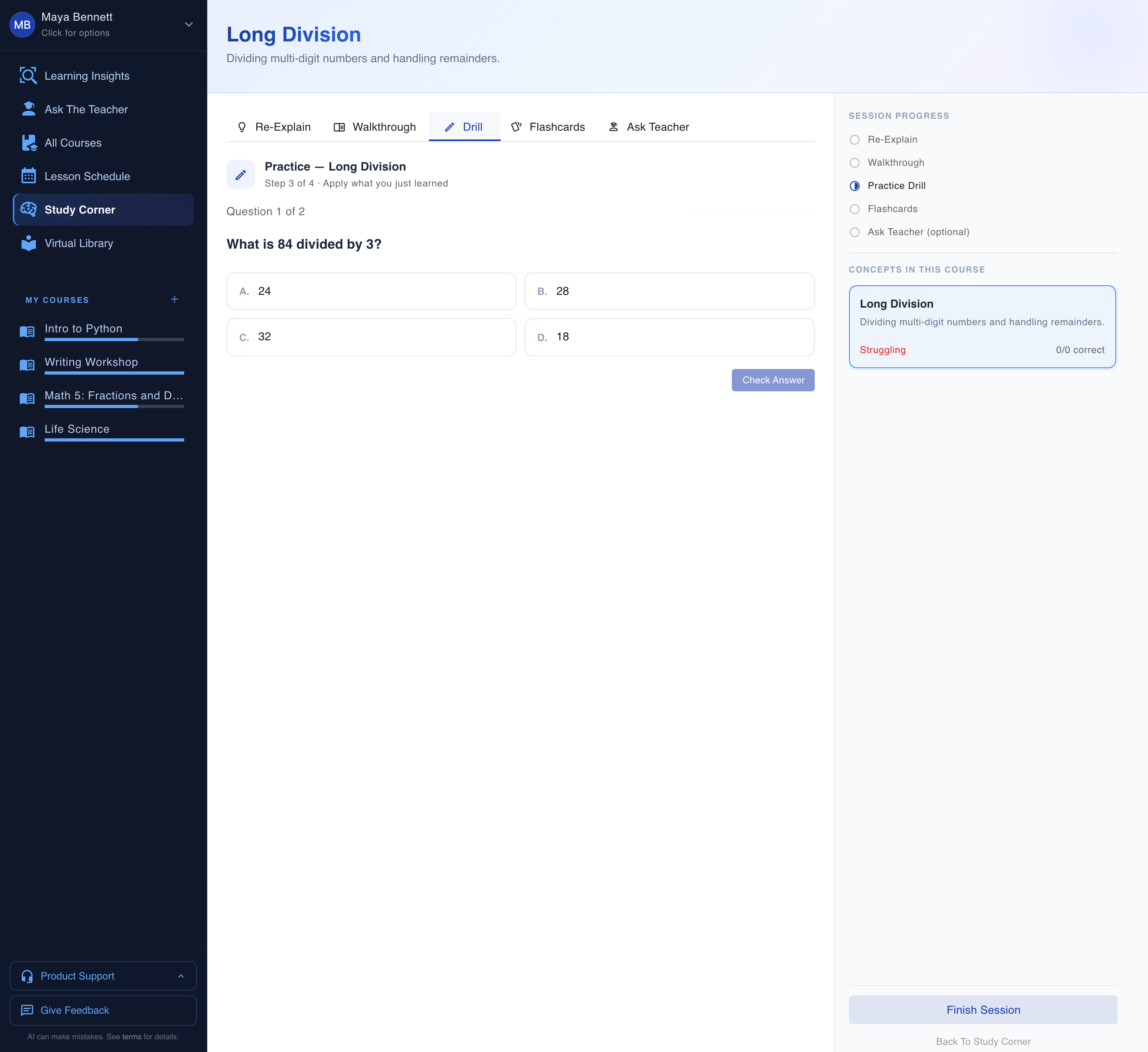
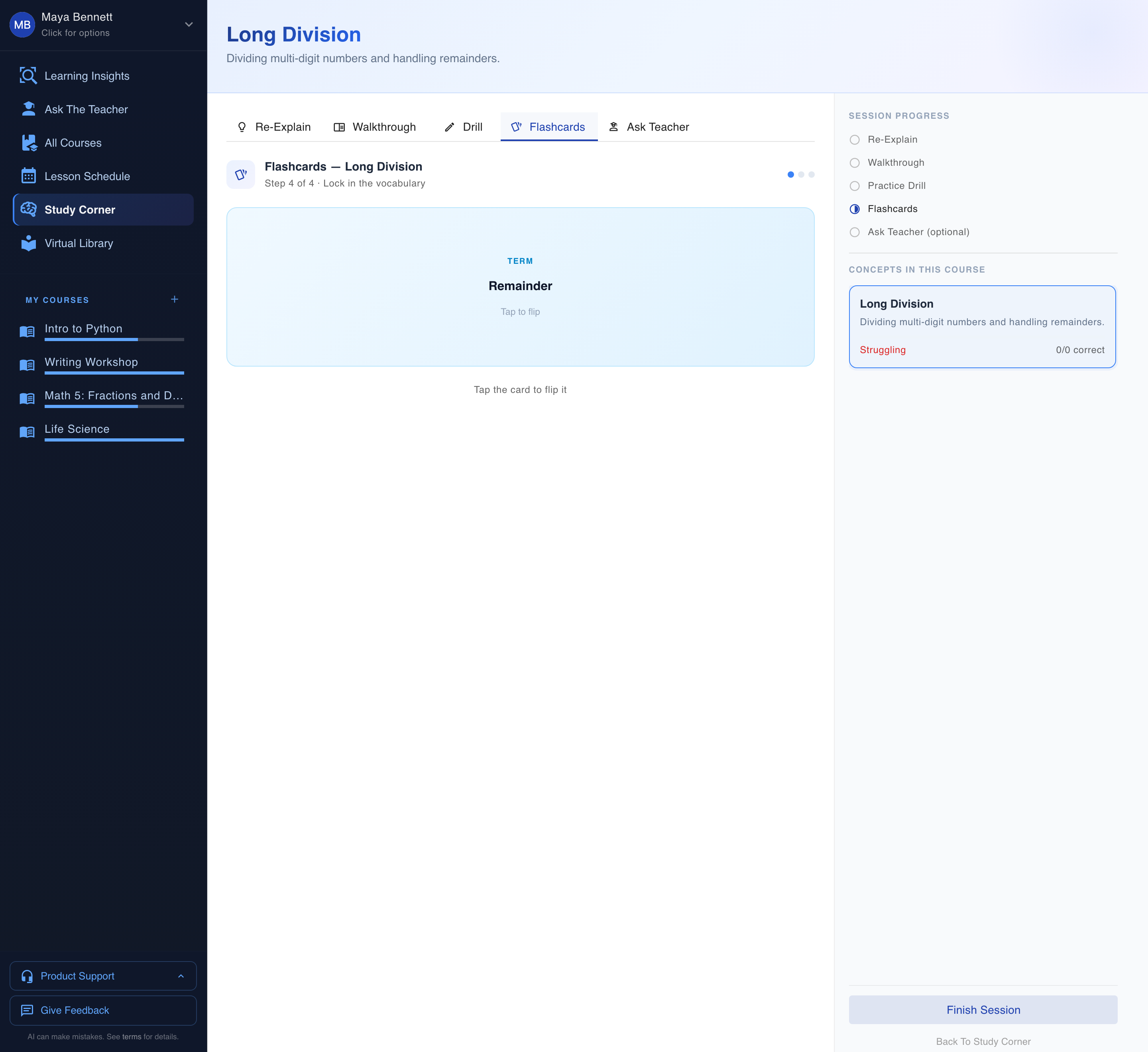
I sequenced those four on purpose, and the order is doing quiet work. Re-Explain comes first because a struggling kid does not need more questions thrown at a misunderstanding; they need the idea rebuilt, ideally through a different door than the one that failed. Walkthrough bridges "I get it when you show me" and "I can do it myself." Only then does Drill ask them to perform alone, and Flashcards seal the vocabulary so the concept has a name they can hold onto next month.
Watch a good tutor work with a confused kid sometime. That is the sequence they run. We put it in software so it fires every time, for every gap, without anyone having to schedule it.
Isn't this adaptive quizzing with a nicer name?
No, and the difference is the whole product. Adaptive quizzing adjusts the difficulty of the next question and keeps moving forward. It never goes back to reteach anything. A Study Corner session (Max AI plan) goes backward on purpose: it re-teaches the broken concept from a new angle, demonstrates it, drills it, then requires proof across multiple attempts before it will call the gap closed.
If you have been burned by "personalized learning" that turned out to be a question picker with a dashboard, that skepticism is earned. Plenty of tools wear the label. The test I would give any of them, ours included, is blunt: when your child bombs a concept, does the software teach it again differently, or does it shrug and serve an easier question? One of those is a tutor. The other is a sorting machine.
Wrong answers compound when nobody comes back for them. A missed concept sits there quietly, gets built on, and surfaces months later as a subject your kid suddenly "hates." So on the Max AI plan, the Study Corner gives you a way back to it. Every wrong answer becomes tomorrow's targeted session, and the loop keeps running until the skill is genuinely repaired.
When does a gap count as truly fixed?
Not when your child clicks through the four activities. A gap closes only when they score 70 percent or better across multiple attempts, so one lucky run can never fake a repair. Once they clear that bar, the concept gets logged as mastered, and that win becomes part of the memory the AI teacher carries into every future lesson.
That last piece matters more than the number. A worksheet is gone the moment you close it. A mastered gap here changes what comes next, because the teacher remembers your child beat this concept and stops treating it as a weak spot. Over months those records add up to an honest picture of how your child learns. If you want the deeper story on that, we wrote about the way the AI teacher remembers how your child learns.
What if your kid already knows what's confusing them?
Then they skip the wait. On the Max AI plan, in custom mode a child can type something plain, like "I don't get long division," straight into the Study Corner, and a full session gets built on the spot. Same four activities, aimed at exactly that topic. No lesson has to flag it first, and nobody has to schedule anything.
That turns a live moment of feeling stuck into a fix while the frustration is still fresh, instead of a vague worry you both forget by dinner. Older kids get the most out of this one. They know when something is fuzzy. Handing them a way to raise their hand and get real help, without waiting on a parent, builds exactly the kind of ownership homeschooling families keep hoping will show up on its own.
Watch it catch a gap you didn't see coming
You were never supposed to catch every gap yourself. Classroom teachers with a decade of experience miss them, because gaps hide inside right-looking work and pleasant afternoons. On the Max AI plan, the Study Corner exists so the catching stops being your job. A concept slips, the platform names it, rates it, rebuilds it, and lets go only after your child proves they own it. You get to be the parent in the room instead of the diagnostician reverse-engineering where the wheels came off.
The free trial runs on the full Max tier, so the Study Corner is live from day one. Have your child work through one honest lesson, then open their gaps the next morning and see what got caught. The first time a wobble gets found and fixed before you ever noticed it, you will know exactly why this is the feature I show people first.
For the bigger picture on what those graded answers reveal, see why real homeschool insights beat a completion checkmark.