10 Signs of Homeschool Curriculum Not Working, Not a Kid Problem
Your kid says they hate math, but the same kid spent forty minutes last week working out the odds of a card game with total focus. That is not a math problem. That is a homeschool curriculum not working for your kid, and no amount of extra worksheets is going to fix a mismatch by adding more of the thing that is not working.
No one can catch every mismatch the moment it starts. A curriculum that fit fine a year ago can quietly stop fitting as a kid grows, and there is no failure in missing that shift while everything else in a homeschool day is competing for your attention. Here are ten signs worth watching for, ranked by how often they get misread as a kid problem instead of a curriculum one.
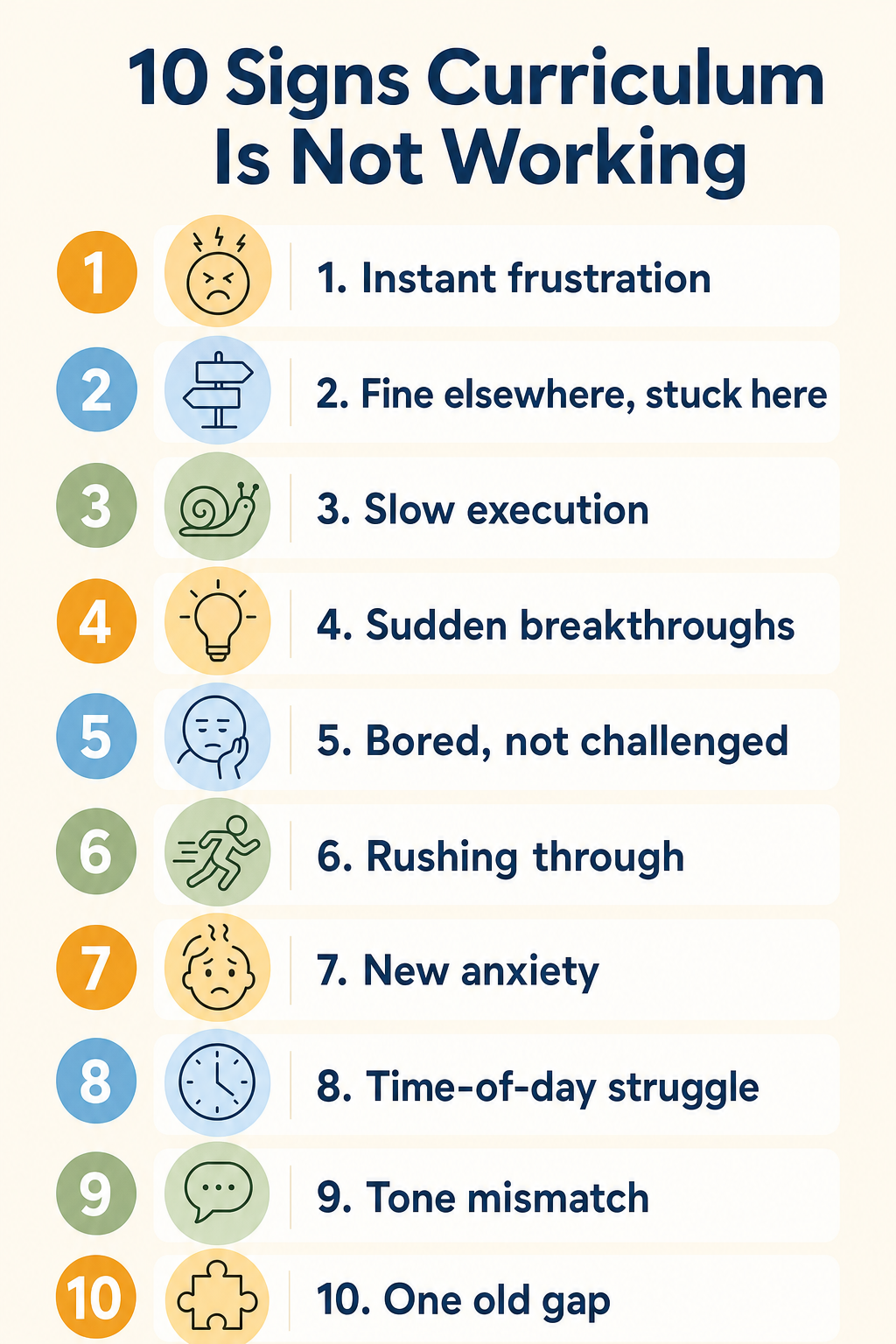
| # | Sign | What it usually means |
|---|---|---|
| 1 | Instant frustration before trying | The format, not the content, is the block |
| 2 | Fine on the topic elsewhere, stuck here | A presentation mismatch |
| 3 | Comprehension fine, execution slow | A pacing or format issue, not understanding |
| 4 | Long stalls, then a sudden breakthrough | Pace was wrong, not ability |
| 5 | Bored through easy material | Curriculum is behind the kid, not ahead |
| 6 | Rushing through to be done | Disengagement, not confusion |
| 7 | Anxious about a subject they used to like | Something shifted and was never adjusted |
| 8 | Only struggles during one time of day | An energy or environment mismatch |
| 9 | Complains about the "voice" of the lesson | A tone mismatch with how the kid receives feedback |
| 10 | One small hole undermining a whole subject | An old gap, never a new failure |
1. Instant frustration before trying
The format of the lesson, not the content inside it, is signaling something your kid has learned to dread before a single problem gets solved. A page dense with tiny text, a video that runs too long before getting to the point, or instructions phrased in a way that does not match how your kid processes language can trigger resistance before the actual material even starts.
This shows up most in kids who have hit the same wall repeatedly with a similar format. The frustration is not about today's lesson. It is an accumulated response to a pattern, and the fastest way to test it is to hand the identical concept over in a different shape and watch whether the wall disappears.
- How to test it: read the same problem out loud instead of handing over the page, or sketch it on a whiteboard instead of the workbook layout. If the resistance drops, the format was the block.
- What it is not: a kid who is simply avoiding effort. Genuine avoidance tends to show up across every format equally, not just one.
2. Fine on the topic elsewhere, stuck here
A kid who understands fractions perfectly well when a parent explains them out loud, but freezes on the exact same fractions in a workbook, is telling you something specific. That is about how the curriculum delivers information, not about their math ability.
This is one of the clearest signals on this list, because it isolates the variable so cleanly. Same child, same subject, same underlying skill, different format, different result. Ask your kid to explain the concept back to you in their own words, away from the page, and see what happens. If they can do it out loud without trouble, the workbook itself is the barrier, not the concept, since a true gap in the underlying skill shows up the same way no matter who is asking or how the question gets framed. When you see this pattern, the fix is almost never more practice on the workbook page. It is a different way in.
3. Comprehension fine, execution slow
A kid who can explain a concept out loud with total confidence but takes forever to complete the written problems is not confused about the material. Something in the execution, the format of the page, the number of steps required to record an answer, the handwriting demand, is slowing them down separately from their understanding.
Watch for this gap specifically. A parent who only looks at completion time can wrongly conclude a kid does not understand something they do, just because getting it onto the page takes longer than expected. The fix usually targets the execution bottleneck directly, not the underlying concept.
- How to test it: let your kid answer the same problem set out loud or by typing instead of handwriting, and compare the time and accuracy.
- What it is not: a comprehension gap. If the verbal explanation is confident and correct, the concept has already landed.

4. Long stalls, then a sudden breakthrough
A kid stuck for weeks on a concept they suddenly grasp in one sitting was likely ready long before the breakthrough. They were just moving at a speed that did not match how their brain needed to encounter it.
A fixed-pace curriculum cannot see this happening in real time. It marks time spent, not readiness. A kid can sit "stuck" on a lesson far longer than necessary because the curriculum has no way to notice they are ready to move faster, or that they need one more angle. Pacing that responds to the kid, not the calendar, catches this shift as it happens instead of weeks later.
The one-line test: a slow start followed by a fast, confident breakthrough is the signature of a pace mismatch, not a ceiling on ability. If a stall passes three weeks with no movement at all, try the concept from a completely different angle before assuming a real skill gap.
5. Bored through easy material
Boredom tells you the curriculum has fallen behind your kid, not ahead of them, which is a mismatch just as real as material that is too hard. A child breezing through pages without any real effort is not experiencing success, they are experiencing time being spent without growth, and boredom often reads to parents as "doing fine" when it is its own type of stall.
This sign gets missed constantly because a bored kid rarely complains the way a frustrated one does. Watch for a kid finishing work suspiciously fast, or one who used to ask questions and stopped. Both can mean the material stopped challenging them a while ago.
- How to test it: hand over material one level up and see whether your kid perks up. A bored kid usually re-engages fast once the difficulty actually matches them.
- What it is not: a kid who is doing well. Fast, effortless completion without any growth is not the same as mastery.
6. Rushing through to be done
A kid clicking through answers as fast as possible, barely reading the question, is not confused. They are disengaged, and rushing is often the fastest exit from a lesson that has stopped feeling worth the effort. This looks similar to boredom but comes with a different signature, sloppy, careless answers instead of quiet coasting.
Slowing a rushing kid down with more instructions rarely helps, since the rushing is a symptom, not the actual problem. Rushing is almost never a personality trait either, whatever it can look like from the outside. Ask your kid to slow down for just one problem and explain their answer out loud, and the careless errors usually clear up fast once real attention returns, which tells you the issue was never carelessness in general, only this specific lesson. The real fix is finding what made the lesson feel like something to escape in the first place, whether that is pace, format, or a string of material that stopped connecting to anything the kid cares about.
7. Anxious about a subject they used to like
A kid who once enjoyed a subject and now dreads it usually is not reacting to the subject itself. Something in how that subject gets delivered shifted, the pace sped up, the format changed, the difficulty jumped, and the curriculum never adjusted to the change it just introduced.
This sign is easy to misread as the subject itself being hard, when the actual story is a kid who liked something until the way it was taught changed underneath them. Tracing back to when the anxiety started, and what changed in the material around that time, usually points straight at the mismatch.
- How to test it: pull up material from a few months back, when the subject still felt good, and compare the format and pace to what your kid is doing now.
- What it is not: a kid outgrowing an interest. Genuine disinterest fades slowly. Anxiety about a subject they used to love tends to arrive fast, tied to a real change.
8. Only struggles during one time of day
A kid who handles a subject fine in the morning but falls apart on the identical type of material in the afternoon is showing you an energy or environment mismatch, not an inconsistent understanding of the content. Attention, patience, and processing speed are not flat across a day for any kid, and a curriculum with no sense of timing cannot account for that.
This sign is worth tracking deliberately, since it is easy to miss without noting when the trouble shows up. Once you see the pattern, the fix is often as simple as moving the hardest material to the time of day your kid has the most to give.
| What you might assume | What is actually happening |
|---|---|
| An inconsistent grasp of the material | The understanding is solid, only the timing is off |
| A random bad day | A repeatable pattern, once you log a week of it |
| A discipline issue in the afternoon | An energy mismatch, not a behavior problem |
9. Complains about the "voice" of the lesson
How a lesson is worded, especially around a wrong answer, can matter as much as what it is teaching. A kid sensitive to correction can shut down from a blunt "incorrect, try again" just as fast as from a genuinely hard problem, and that reaction has nothing to do with whether they understand the material.
Tone mismatches are easy to miss because the complaint often gets phrased as "I hate this" rather than anything specific. A platform that adjusts feedback wording to how a specific kid receives it, gentle redirection for one child, direct and specific for another, removes this variable entirely rather than asking every kid to tolerate the same voice. Our post on how six AI teacher personas get matched to a kid's actual personality goes deeper on how tone gets paired to the learner.
- How to test it: rephrase a correction yourself in a softer or more direct tone, whichever your kid does not currently get, and see if the reaction changes.
- What it is not: a kid who dislikes being corrected in general. Most kids tolerate correction fine when the wording actually fits how they take it.
10. One small hole undermining a whole subject
A kid who understands most of a math unit but keeps making the same specific type of error across many different problems is usually carrying one missed concept from further back, not struggling with the current material at all. One small, old gap can look like a much bigger problem than it is.
This is exactly the pattern a targeted gap check is built to catch, because it names the one underlying concept instead of flagging the whole subject as weak. We wrote up how gap detection works and rebuilds one specific concept at a time, which covers why this precision matters more than reviewing an entire unit from the top.
- How to test it: look across several wrong answers for a repeated pattern, the same type of step failing, rather than treating each miss as unrelated.
- What it is not: a sign your kid needs to relearn the whole unit. One traced-back concept is usually all that needs rebuilding.
What if my child really is falling behind?
Sometimes the curriculum isn't the problem, and your child really has fallen behind in one area. That's normal, and it's fixable. "Behind" is almost never a whole subject. It's usually two or three specific skills from earlier units that never quite landed. When you find those skills, catching up stops being vague and becomes a short, concrete list.
First, rule out a mismatch. Teach the same concept a different way, or on a calmer day. If your child gets it, the curriculum was the mismatch. If they miss it the same way no matter how it's framed, you're looking at a real gap.
Then trace it back. Start with the lesson your child is stuck on and ask what it quietly assumes they already know. Long division, for example, assumes fluent multiplication facts. If your child hesitates on 7 × 8, the gap is the times tables, two levels below the lesson that exposed it. Keep asking "what came before this?" until you reach a skill your child can explain back to you comfortably.
Re-teach in order, then return. Give the missing skill its own short daily block, 15 to 20 minutes, while the rest of the week carries on at a lighter load. Rebuild the skill first, then go back to the lesson that exposed it. Holding the whole subject back is rarely necessary. Hold the level only if the missing skill blocks the next several lessons.
Check that it stuck. A few weeks later, ask your child to explain the skill again with no example in front of them. If they can teach it back, the gap is closed. If not, change the format rather than repeating the same explanation.
Tracing a struggle back to the one missing skill goes deeper on each step. If you'd rather not do the tracing by hand, AI Home Academy's gap analysis runs after each lesson and quiz and names the concepts your child hasn't mastered. On the Max AI plan, your child can also open a Study Corner session on any of them.
Is your homeschool curriculum not working for more than one reason?
That is common, and it usually points to a curriculum that fit at one point but has drifted out of alignment across several dimensions as your kid grew. Pace, tone, and format tend to move together, since a curriculum built around an average kid at one age rarely keeps up with the specific kid that same child becomes a year or two later.
The fix is not to diagnose each sign separately. It is to look for an approach where pace, tone, and format all adjust to the kid continuously, rather than being fixed at the moment the curriculum was written. That is the difference between a one-time purchase and something built to keep fitting as your kid changes.
Is it normal for a homeschool curriculum to stop working after a while?
Yes, and it happens to almost every family at some point. Kids change pace and interests as they grow, and a curriculum that fit a year ago can quietly stop fitting without anyone doing anything wrong.
Should I switch curricula every time my kid struggles?
Not automatically. Some struggle is a normal, healthy part of learning something new. The signs in this post point at a mismatch specifically, a pattern that repeats across a curriculum rather than one hard concept your kid is still working through.
The real takeaway, and where to start
None of these ten signs mean your kid is behind, and none of them mean you missed something you should have caught sooner. They mean the curriculum and the kid have drifted apart, which happens to nearly every homeschool family at some point, quietly and without anyone doing anything wrong.
Start by picking the sign that sounds most like what you've been seeing, and test whether the same concept lands differently in a different format. If it does, the curriculum was the mismatch. If it doesn't, you've found a real gap, and the section above shows how to trace it and close it.