Built for the Kid Who Never Fit the Box
A lot of families never chose homeschooling. School chose for them, by breaking something first. The bright kid who got written up as a behavior problem for not sitting through a worksheet. The gifted kid quietly dying of boredom in a class three years below where their head lives. The one who worked twice as hard as everyone else and burned out by fifth grade. You did not pull your kid out because it looked easy. You pulled them out because the box was hurting them.
So here is the direct answer to what a better setup looks like. A platform that captures who your child actually is, then bends the teaching to fit them, instead of asking your child to bend to it. Standard curriculum was built for an average kid who does not exist. This one starts from the specific human you are raising.
This one is personal for me. I built AI Home Academy partly for my own daughter, who has ADHD, a kid whose brain is fast, funny, and allergic to the way most lessons get delivered. The material was never the problem. The delivery was, and nothing on the market would bend. So I built the thing that bends.
Who was your kid's curriculum actually written for?
An imaginary average. A child who reads on grade level, sits for forty-five minutes, works for a gold star, and laughs at the same textbook joke as the class next door. Real kids scatter across every one of those axes. When a real kid misses the template, most curriculum reads it as the kid failing, not the template being wrong. Homeschooling often starts the morning a parent refuses that verdict.
Here is the quiet damage in that setup. A curriculum built for the middle treats variance as a defect. The kid who needs to move gets marked as a distraction. The kid who reads ahead gets marked as impatient. The kid who processes slowly gets marked as behind. Every one of those is a fit problem wearing a learning problem's label, and fit is the one thing a printed workbook can never adjust.
What does the platform actually know about your child?
More than a grade level. When you set up a learner, you describe the real child: their learning style, how fast or slow they need to move, and any special considerations. Then the softer stuff, what motivates them, how much humor they can take, how they want feedback worded, and what they are into. You fill it in once. That profile becomes the instruction set behind every lesson your child ever opens.
Look at what those fields are really doing. Special considerations is a free text box, so you can write "needs instructions one step at a time" or "shuts down when corrected bluntly" in your own words. Interests is not decoration. If your kid lives for dinosaurs or basketball, the examples in a fraction lesson can come from there. Feedback style decides whether a wrong answer gets a gentle redirect or a straight fact. You are teaching the platform your kid before the first lesson runs.
How does knowing all that change the actual lesson?
The profile picks the teacher, sets the pace, and words the feedback. A learner who needs predictable, literal structure gets matched to Nova, who is specific and steady and never buries the point in fluff. An ADHD learner who runs on momentum gets Spark, who teaches through story and keeps the energy up. Same math underneath. A completely different delivery on top.
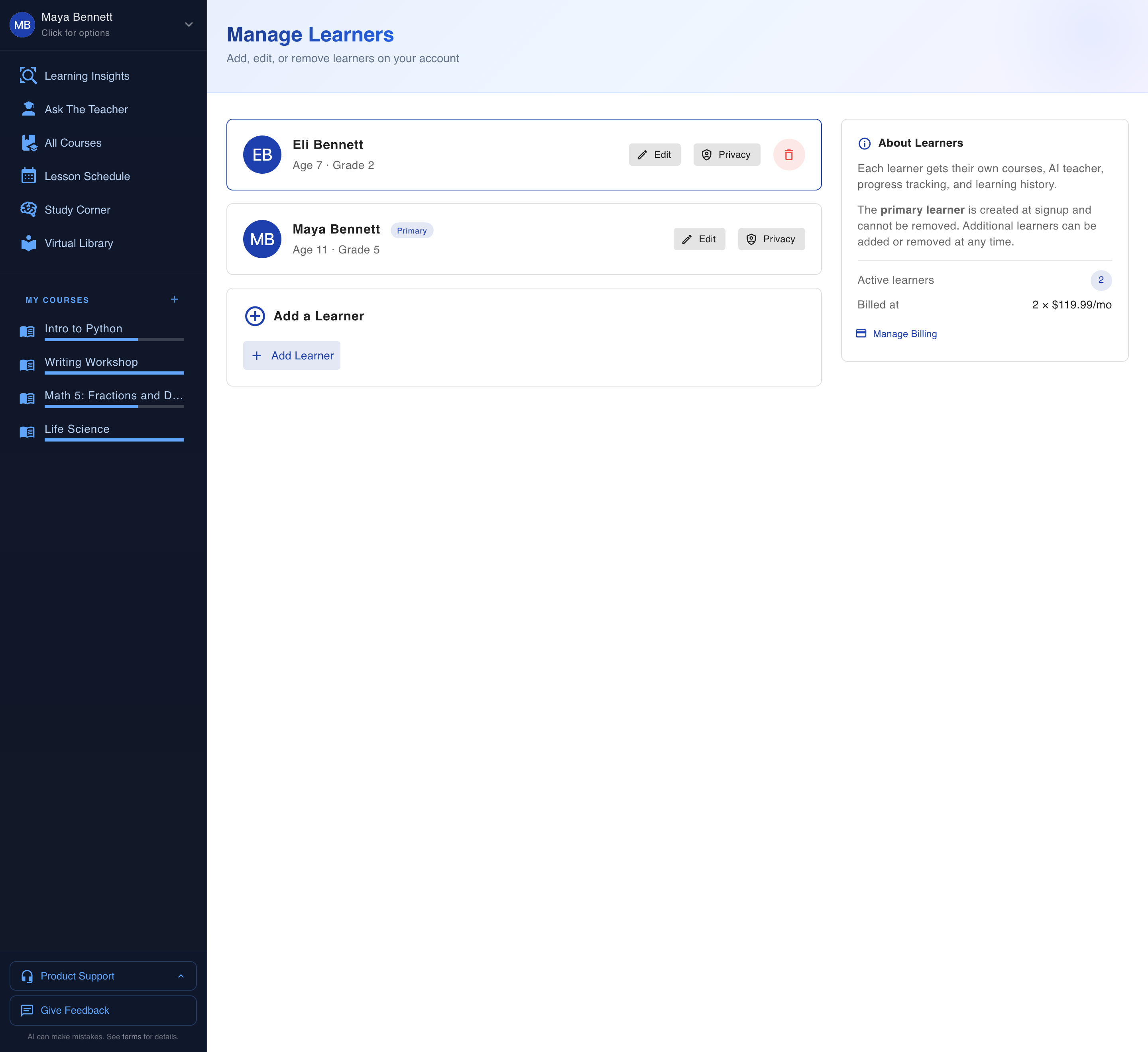
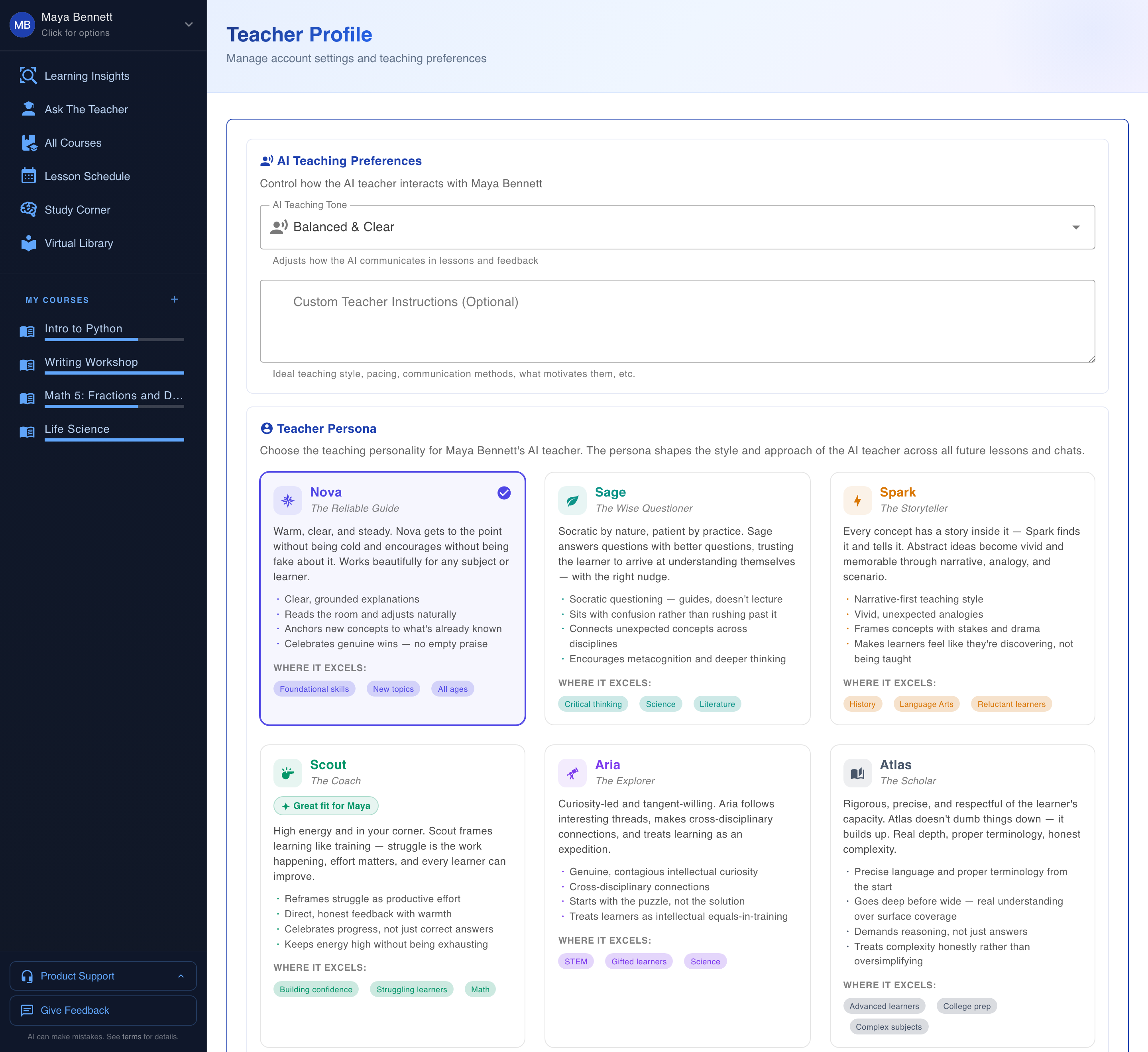
Pacing bends too. A kid who needs shorter bursts gets shorter bursts, not a forty-minute block they will abandon at minute six. Framing changes with the interests you listed. Feedback lands the way you said your kid can hear it, because a correction that shuts one kid down will roll right off another. If you want the full breakdown of who each teacher is and how the match gets made, we wrote up the six teacher personas and how each match gets made.
This is the part generic edtech skips. Most tools personalize the difficulty and call it a day. They serve the same lesson, same voice, same pace, and only nudge the questions up or down. Difficulty is one dial. The one that decides everything is whether the kid can receive the teaching at all.
How do you homeschool a neurodivergent or gifted kid?
You start from how that specific child learns, not from the diagnosis. You write what your kid needs into their profile, and the platform fits the teacher, the pace, and the wording to match. An ADHD kid gets short, high-momentum lessons. A kid who needs predictable structure gets literal language and one step at a time. A gifted or twice-exceptional kid gets depth where they are ready and patience where they are not.
| Your learner | What you might write in the profile | How the lesson adapts |
|---|---|---|
| ADHD | short bursts, needs momentum, gentle redirects | Spark persona, shorter lessons, story-driven framing |
| Needs predictable structure | predictable structure, literal wording, one step at a time | Nova persona, steady pacing, no fluff or surprises |
| Gifted or twice-exceptional | reads years ahead here, genuinely stuck there | pacing set per subject, harder material where ready |
| Slow to process | needs time, shuts down when rushed | longer runway, no timer pressure, calm feedback |
None of this is a fix for a broken kid. It is the ordinary courtesy of teaching a person the way they actually take in the world. A room of twenty-five children cannot do this for each one, and no one should pretend a single teacher failed for not managing it. A platform can hold all of these at once, quietly, one profile at a time.
Does my kid get flagged as the one who needs extra help?
No. There is no special packet, no separate track, no label stapled to the top of the page. The accommodation is invisible. The lesson simply fits. Your child opens it and sees work that makes sense to them, not a modified worksheet with their difference announced in the margin. They are not the labeled kid in the room. They are a kid doing a lesson that happens to work.
If you have watched a child clock the "special" version handed only to them, you know why this matters. Kids read that signal instantly, and it teaches them they are the problem. Here the fit is baked into the ordinary lesson. The pacing, the persona, the wording, all of it moves quietly under the hood. Your kid gets the support and keeps their dignity, which are usually sold as a trade and should never have been.
Why does catching gaps matter more for a kid like mine?
Because these kids fall through the cracks fastest. A distracted morning, a concept half-heard, one bad night of sleep, and the hole is there before anyone notices. On the Max AI plan, a Study Corner session works from your child's actual graded answers, names the exact concept they got shaky on, and rebuilds that one skill. Not a blanket "behind." The specific gap, caught early, while it is still small.
That precision is everything for a kid whose attention or processing already makes them uneven. A generic "review this unit" buries the real problem under an hour of stuff they already know, which is exactly the kind of busywork that makes a struggling kid quit. Fixing the one concept that actually slipped respects their time and their effort. For the full mechanics of how a gap gets caught and rebuilt, see how gap remediation works in the Max AI Study Corner.
| What the box does | What a fitted platform does |
|---|---|
| One lesson, one pace, one voice for every kid | Persona, pacing, and framing set by the child's profile |
| Hands the "different" kid a visible modified packet | Bakes the accommodation into the ordinary lesson |
| Marks a whole unit "behind" | Names and rebuilds the one specific gap |
| Treats variance as a defect | Treats variance as the starting point |
What if my kids are nothing alike?
Then each one gets their own profile under a single account. A twice-exceptional kid, years ahead in math and genuinely fighting for every page in reading, gets a fit built for exactly that split, because pacing and difficulty are set per subject rather than stamped on the whole child. Their neurotypical sibling gets a profile of their own. Same family, same login, two completely different classrooms running side by side. Nobody gets averaged against anybody.
This is where the whole idea earns its keep in a real house. Most families are not raising one type of learner. They are raising a fast, distractible one and a careful, methodical one and maybe a third who defies both descriptions. A platform that only knows a grade level cannot serve that. One that knows each kid as a specific person can hand all three the right lesson on the same Tuesday morning.
The real promise, and where to start
Here is the honest version. The promise is not that your kid finally fits the curriculum. It is that the curriculum finally bends to your kid. Every lesson pulls from a profile you wrote about a child you know better than any system ever will. The fit shows up as a lesson that simply works, with no label and no separate table in the corner.
Start with the profile. The free trial runs on full Max tier, so every persona, the full Study Corner, and per-learner profiles are all live from day one. Set up your kid the way you would describe them to a tutor who actually cared, considerations and interests and all. Run one lesson. The first time you watch your specific, wonderful, box-defying child open something that fits them without a fight, you will get why this was worth building.