The Book Series That Stars Your Kid
You know the kid who never picks up a book on their own. The one who treats reading like a chore you invented to ruin the afternoon. Then one night they look up from the story they are somehow still reading and quietly ask if there is a next one. There is.
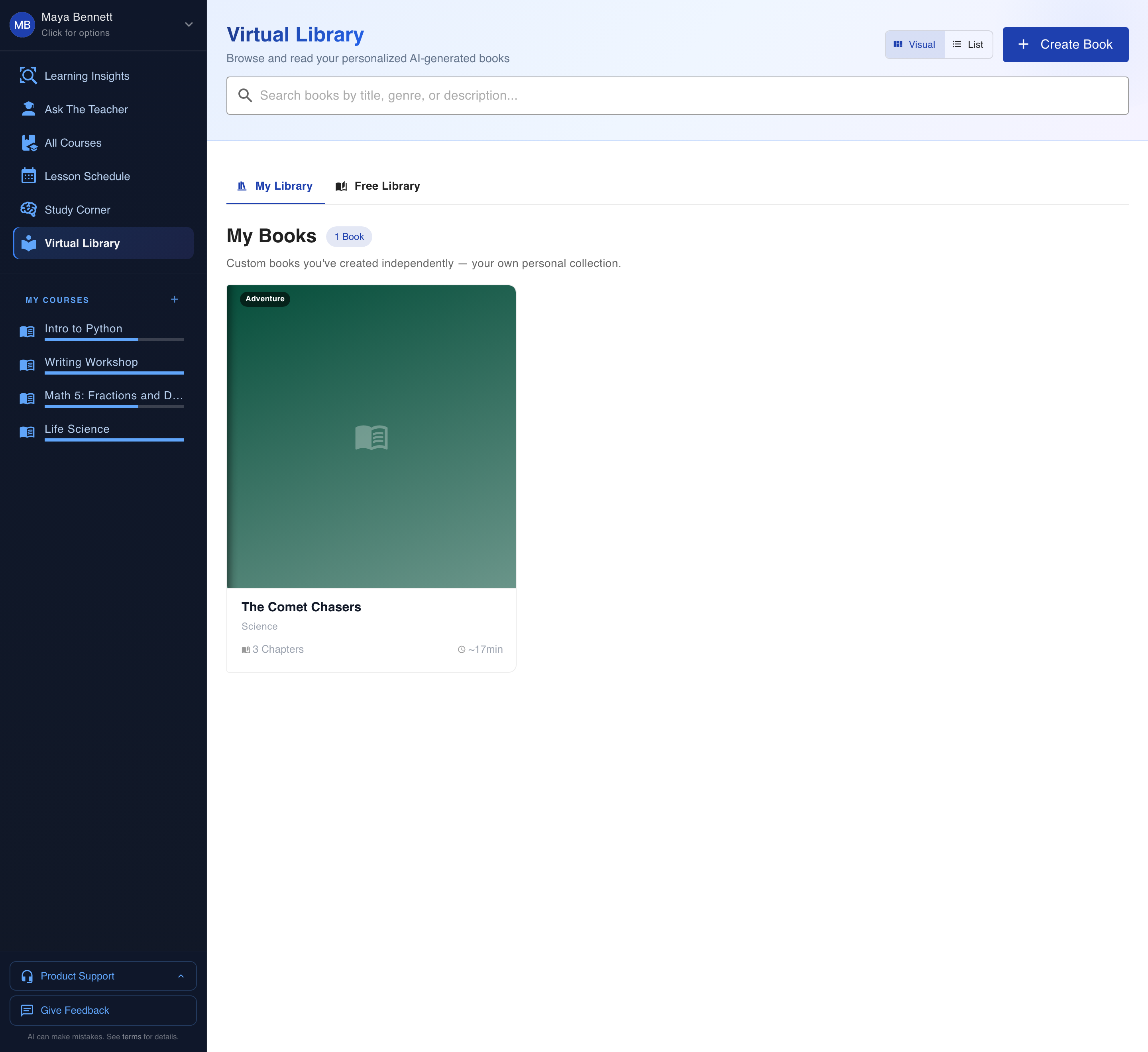
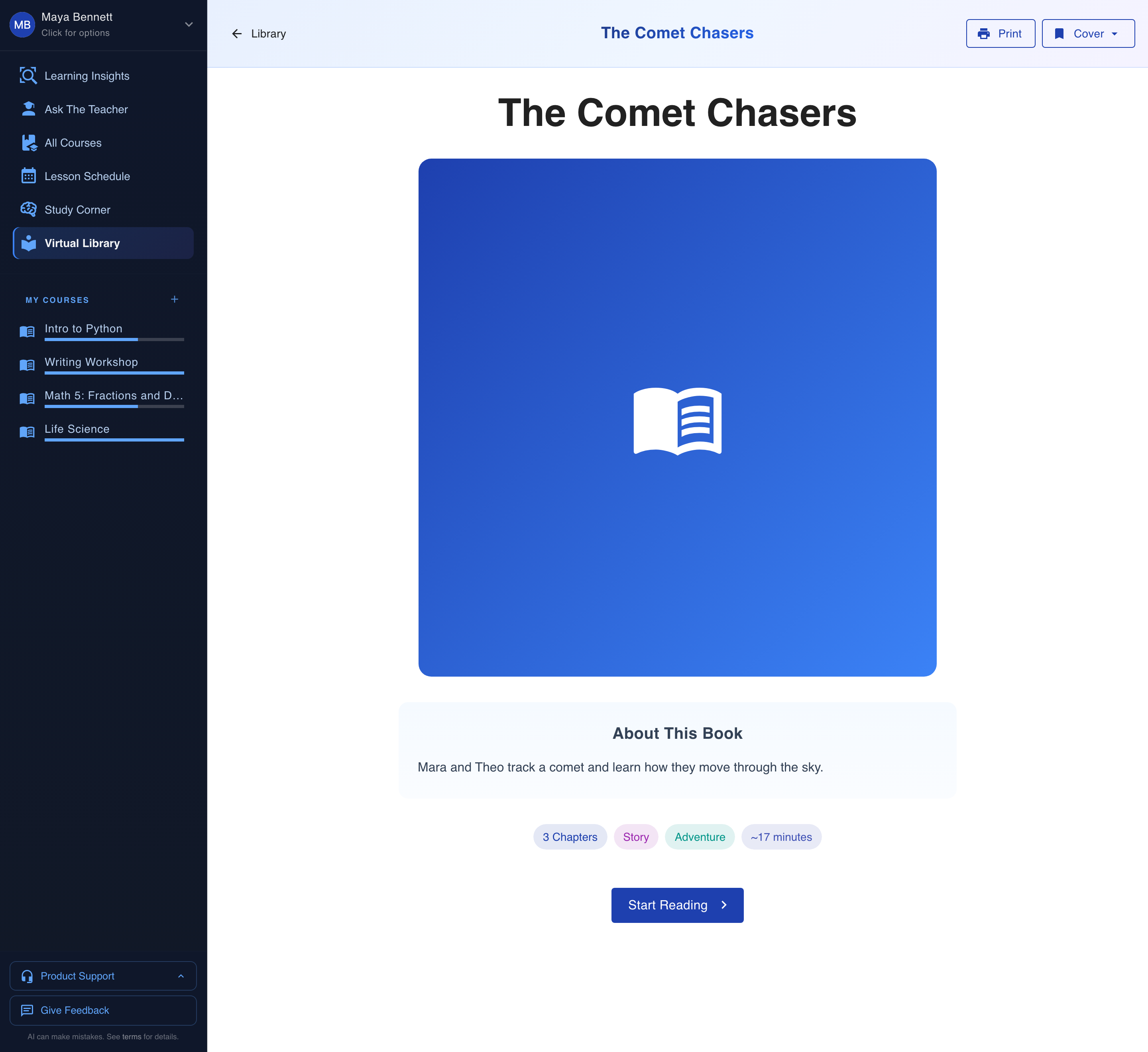
Every course your child finishes builds a full custom illustrated book, 8 to 14 chapters, a custom cover, pictures inside, written at their level and set in the world they love. A new book can continue up to three earlier ones. The series is real, and it is theirs.
Most learning tools hand your kid a score and move on. This hands them a book.
What is a custom illustrated book from an AHA course?
A custom illustrated book is a complete story AHA writes from a course your child just finished: 8 to 14 chapters, a custom cover, and original art inside. It is set in a world your child loves and written at their exact reading level. Finish a course and the book comes out the other side, with the lesson living inside the plot. It reads like a real book, because it is one.
The story leans into their interests, so a child obsessed with sharks can learn fractions through a deep-sea expedition. The reading level matches where your kid sits that day, not a grade sticker on a shelf.
The interests part matters more than it sounds. A kid who loves horses does not want a generic story with a horse pasted in. The book is anchored to what they care about from the start, so the subject and the story are one thing, not two.
And the writing tracks their reading level. A newer reader gets shorter sentences and more pictures. A stronger reader gets more on the page. Same course, different book, because it is built for the child in front of it.
Think about what a course usually leaves behind. A grade, a percentage, maybe a printable certificate that goes in a folder nobody opens again. The book is a different kind of ending. Your child spent a week on ancient Egypt or long division, and instead of a number, they get a story where they crossed the desert or cracked the puzzle themselves. The learning is baked into the plot, so rereading the book is rereading the lesson without it feeling like review.
How do the sequels and series continuity work?
A new book can continue up to three earlier books, carrying the same world, characters, and open story threads forward. A compact lore record travels between the books, remembering who is who and what is still unresolved, so the dog from book one still answers to the same name in book four. That record is what turns single titles into a real series your child asks to keep reading.
Here is why that record matters. Without it, a "sequel" is a new story wearing old names. Details drift. The character who was scared of water in book one is suddenly a swimmer in book three, and a kid notices that instantly. The lore record is the memory between books that keeps the world honest.
Pulling from up to three previous books gives a new one a real backstory to build on. The world gets deeper each time instead of resetting. A kid who read three books about the same crew of explorers opens the fourth already knowing them, which is exactly how a favorite series works on a real shelf. The familiarity is the hook, and here the familiarity is earned across actual learning.
| Piece | What you get |
|---|---|
| Chapters | 8 to 14 per book |
| Cover | Custom art made for that book |
| Illustrations | Inside the chapters |
| Reading level | Matched to your child |
| Sequels | Continue up to 3 earlier books |
| Reader tools | Read-aloud audio, notes panel |
Why will a reluctant reader pick up this book?
A reluctant reader picks it up because it is theirs. Their name, their world, the stuff they already love, on the page, reading like a story instead of a worksheet with a plot glued on top. It also holds what they learned, so the reading and the learning happen in the same breath. Having a reluctant reader is common and never a failing, and this removes the two reasons kids usually quit.
Those two reasons are simple: the story feels like it has nothing to do with them, and it reads like homework. Take both away and a lot of kids meet you halfway. I want to be honest about the limits, though. A book that stars your kid is not a magic wand that turns every child into a bookworm overnight.
But I have watched the difference at my own kitchen table. My daughter loses interest in reading that feels like a chore in about a page. A book about her, set in a world she picked, holds on a lot longer. That contrast is half the reason this feature exists.
The starring part is not a gimmick either. When a kid sees a version of themselves solving the problem in the book, the reading stops being about a stranger and starts being about them. That shift is small on paper and big in practice. A child who will not sit still for a chapter about someone else will sit for a chapter about their own adventure. By the end of it they have read a full book without once being told to.
What tools are built into the book reader?
Two tools sit right inside the reader. Read-aloud audio lets a pre-reader or a worn-out kid listen while they follow the words, and a notes panel catches the questions and thoughts that pop up mid-chapter. The audio pulls extra weight with reluctant readers, because listening lowers the wall before they try to climb it on their own.
The notes panel is quieter but useful. A kid can mark the part that confused them or the line they loved, and you have a real window into what landed. It beats asking "so what did you read today" and getting a shrug.
For a homeschool parent juggling more than one kid, the audio is also a way to buy yourself a few minutes. One child listens to their book while you sit with another. Nobody is stuck waiting on you to read out loud, and the reluctant reader still gets the story in their ears.
Where does the book fit with the rest of the learning?
The book is one piece of a finished course, not the whole thing. The same course sends real-world assignments off the screen that come back and get graded. When a gap shows up in what your child understood, the Max AI plan's Study Corner works it until it closes. The book is the keepsake at the end, so a finished book means a finished course, with real learning sitting behind a real object.
So the book is not decoration bolted onto a lesson. It is the visible result of the work, the part your child can hold up and show someone.
One quiet upside of that setup: a series can grow across subjects. Book one might come out of a science course and book two out of a history course, both set in the same world your child chose, because a sequel continues the earlier books no matter what they were learning. A kid ends up with one running story that happens to cover half a curriculum.
The shelf test
Most edtech leaves nothing behind. A streak, a badge, a checkmark that blinks out the moment you close the tab. This leaves a book. A real, finished thing about your child, holding what they learned, that sits on their shelf in the Virtual Library, can be pulled up to show a grandparent, and reads just as well a year later.
Try it. Ask a kid to show you their math app. Then ask them to show you their book. Watch which one they reach for. Other platforms stop at the completion mark. AHA gives your child something to keep, and a reason to ask for the next one.
That is the difference between finishing a lesson and finishing a book. One disappears. One goes onto their shelf, with your kid in the story, and it stays there.
Try it on your own kid's obsession
Pick the thing your child cannot stop talking about this month. Dragons, drum kits, the deep ocean, whatever it is. Run a course on a subject you want them to learn, and let the book come out the other side wearing that obsession. Then build the sequel and watch them notice that the world remembered.
The free trial is the full Max tier, so every part of this is live from day one. The book, the sequels, the read-aloud audio, all of it. Nothing is locked behind an upgrade while you are trying it out. Start a course tonight, and by the time it is done your reluctant reader has a first book with their name on it, and a reason to ask for the second.