Real Coding for Kids, Not Drag-the-Blocks
Your twelve-year-old has outgrown the colored blocks. They can feel it too, still snapping puzzle pieces together while a real game or website sits half-built in their head, just out of reach. And you cannot teach them Python, because you never learned it either. So you are both stuck at the same wall, staring at it.
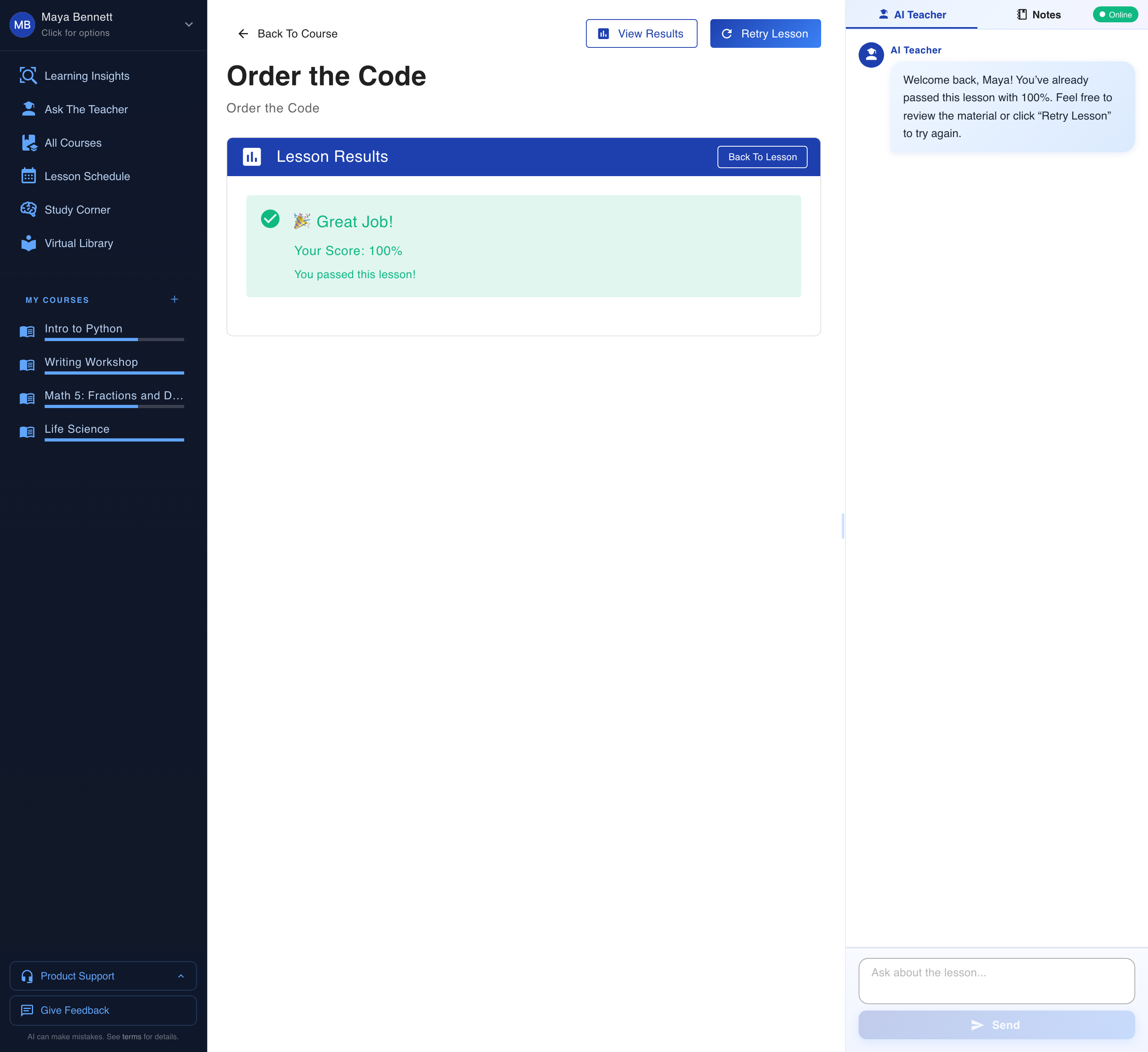
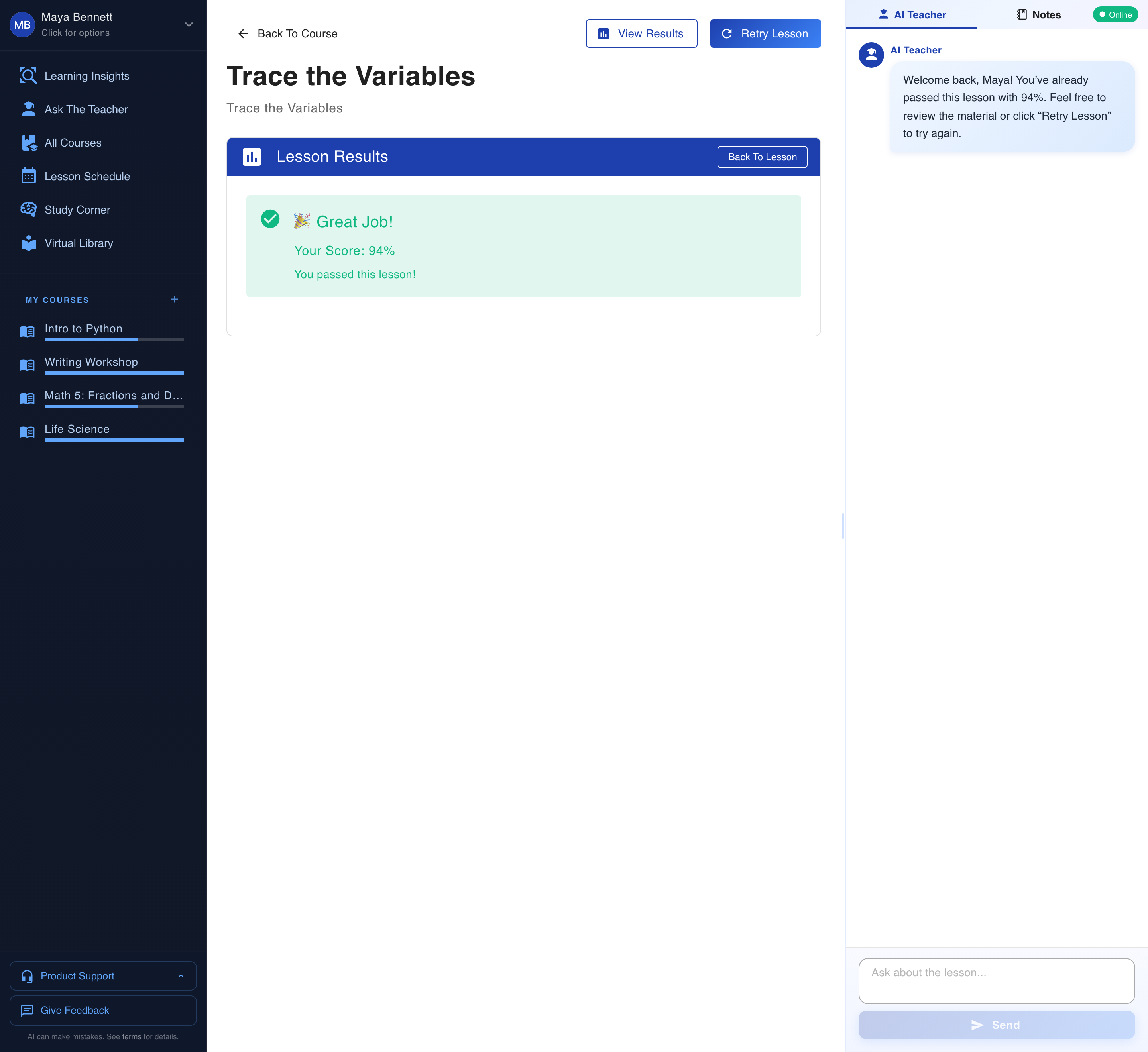
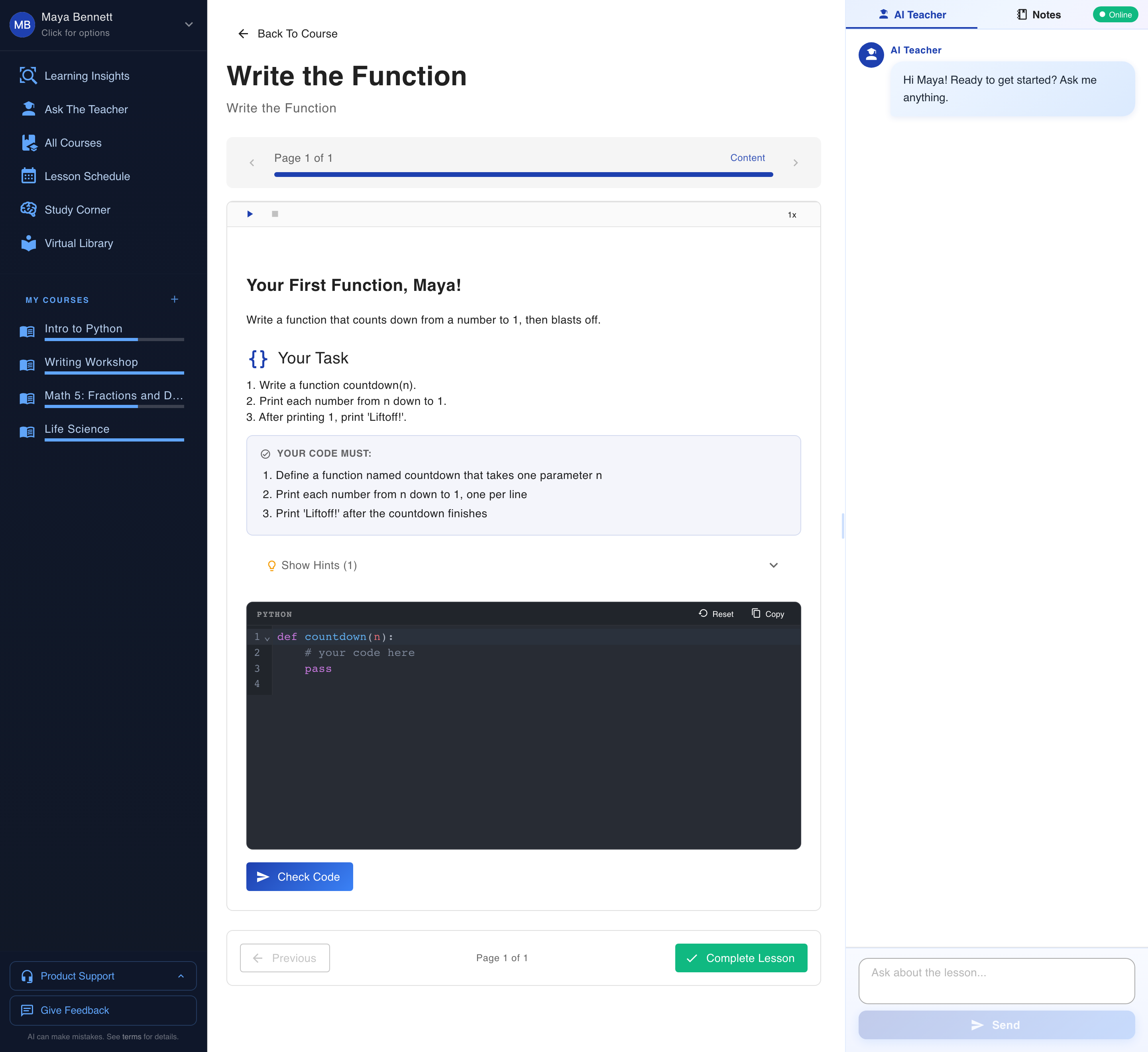
Here is the way through. A real coding course for kids teaches Python, JavaScript, or Java with real syntax, runs and reviews the code, and hands specific feedback back to the kid. You never write a line or grade a thing. The AI does that part.
That is the short version. Here is what it looks like up close, and why it matters more than it sounds.
What does a real coding course for a kid look like?
A real coding course for kids teaches an actual programming language with real syntax, lets the child write and run code, and has the software check and explain the results. So it looks like the tools working programmers use, sized for a kid: Python, JavaScript, Lua, HTML and CSS, and Java. Not a drag-and-drop sandbox. Your kid types code, runs it, sees it break, and fixes it. The AI explains what went wrong in plain words, so nobody at your kitchen table has to know Java to keep the course moving.
There is a reason to start with the block editors, and I want to be fair to them. For a seven-year-old, dragging colored pieces around teaches the shape of an idea. Loops. If-this-then-that. Sequence. Those concepts are the whole game early on, and blocks make them visible without the pain of a missing semicolon.
The problem is what happens next.
Why do the colored blocks stop working?
Blocks are a great on-ramp and a lousy destination. They are fine at seven and a dead end at twelve, when a kid who wants to build something real is still snapping puzzle pieces together. At some point the child has a project in their head, a game, a website, a small tool, and the blocks simply cannot express it. The ceiling arrives quietly. One week they are motivated, the next they are bored, and it reads like they lost interest in coding.
They did not lose interest. They outgrew the training wheels and nobody handed them a real bike.
Real syntax is the bike. Typing for i in range(10) instead of dragging a loop block feels harder for about a day. Then it opens up. Now the kid can look at code on any screen, in any tutorial, anywhere on the internet, and recognize it. That transfer is the point. Blocks are a private language that only exists inside one app. Python exists everywhere.
Here is the honest tradeoff, laid out.
| Block coding | Real coding course | |
|---|---|---|
| Best age | Roughly 6 to 10 | Roughly 10 and up |
| What it teaches | Concepts, logic shapes | Concepts plus real syntax |
| Transfers to real work | No, it stays in the app | Yes, it is the actual language |
| Ceiling | Hits fast once projects get real | Goes as far as the kid does |
| Who grades it | You, usually | The AI runs and reviews it |
What kind of exercises does a kid actually do?
They do the good kind, the ones that build a coder instead of a copier. A real course mixes several exercise types so a kid reads code, writes it, predicts it, and repairs it, then ships something whole. Each one trains a different muscle, and the difficulty climbs on purpose so nobody stalls at a blank screen.
Here are the main exercise types a kid works through:
- In-browser code editor: write and run real code, then get it reviewed.
- Fill-in-the-blank code: practice a new pattern without facing a blank page.
- Variable tracing: step through the code line by line and predict each value.
- Spot-and-fix-the-bug: find the one wrong line, which is most of real programming.
- Parsons problems: reorder scrambled lines into a program that actually runs.
- Multi-step projects: build something whole across several stages.
A kid who only ever writes code from a blank screen gets overwhelmed and quits. A kid who only ever answers multiple-choice about code never learns to type it themselves. The mix exists to keep both of those kids moving.
Take the bug-fixing ones. Handing a kid working code and asking them to break it, then fix it, teaches more than a hundred perfect examples. Real programming is mostly reading code that is almost right and figuring out the one thing that is wrong. Starting that habit early is a gift.
The Parsons problems are sneaky good too. The kid gets all the correct lines of code, just shuffled, and has to put them in order. It removes the blank-page terror while still forcing them to think through the logic. They cannot fake it. The order has to actually run.
Tracing a variable is the one parents underrate. You walk through the code one line at a time and watch a value change. It sounds dull. It is the exact skill that separates a kid who guesses from a kid who understands, because they can predict what the machine will do before they run it.
Then the multi-step projects pull all of it together. Instead of one tiny exercise, the kid builds something across several steps: set up the pieces, write a function, test it, fix what breaks, add the next part. This is where coding stops feeling like worksheets and starts feeling like making something. The fill-in-the-blank drills and the bug hunts were the reps. The project is the game they were training for.
Reading code, writing code, predicting code, repairing code, shipping something whole. A course that only drills one of those muscles turns out a lopsided coder. Together they produce a kid who can sit down in front of a blank file and not panic, which is the actual finish line.
How do I support this if I've never written code?
You don't grade it, and you don't debug it. That is the whole design. The AI runs the code and reviews it, so a parent who has never written a line is never on the hook to judge whether an answer is right. The kid gets specific feedback, the kind that says what broke and why, not a cold "wrong" with no map back to the fix.
That last part is where most self-teaching falls apart. A kid writes ten lines, hits run, and gets a red error message written for professional engineers. It might as well be in Latin. They stare at it, feel stupid, and close the laptop. "Why won't this run" is the single most demoralizing moment in learning to code, for a twelve-year-old and a forty-year-old alike.
So the AI teacher is there for exactly that moment, at any hour. Ten at night, you are asleep, the kid is one stubborn typo away from a working program. Instead of quitting in frustration, they ask, and they get a real answer that meets them where they are stuck. Not the solution handed over, the nudge that gets them unstuck.
If your kid learns better with a certain kind of teacher, that is handled too. The tone of that help can shift to match your child, which I wrote about in six AI teacher personas matched to your child. A patient, gentle guide for the anxious kid. A dry, straight-shooting one for the kid who hates being coddled. Same code review, different bedside manner.
I will be straight with you about why this matters to me. I built a lot of AHA around my own daughter, who has ADHD, and the coding piece especially. A kid who cannot sit through a lecture will happily spend an hour hunting one bug, if the feedback loop is fast and the help is right there. That is the bet.
Is it a real course or a pile of puzzles?
It is a real course. Structure, pacing, a sequence that builds. A lot of coding-for-kids products are secretly a bucket of disconnected challenges, and the parent is quietly expected to be the curriculum designer who orders them. That is not this. The exercises are arranged so each one leans on the last, and the difficulty climbs at a pace a kid can hold.
And when a kid keeps missing the same thing, the course notices. If loops are the wall they keep hitting, that gap gets caught and worked on directly instead of scrolling past. That is the same engine behind the rest of AHA, which I broke down in how Study Corner gap remediation works on the Max AI plan. Most platforms mark a lesson complete and move on. A completion checkmark is not the same as understanding, and pretending it is fails the kid quietly, one skipped concept at a time.
The difference shows up months later. One kid can drag blocks and thinks they can code. Another can open a real file, read it, and change it. Only one of those kids can keep going on their own.
What to do with a bored block-coder
If your kid is seven and loving blocks, leave them there and enjoy it. If your kid is eleven or twelve and getting bored, that boredom is a signal, not a verdict. They are ready for the real thing, and the real thing does not require you to become a programmer overnight.
Start a free trial. It runs on the full Max tier, so every piece of this is live: the real languages, the in-browser editor, the code review, and the AI teacher for the "why won't this run" nights. Let your kid write ten lines of Python that actually run, and watch what happens to the boredom.