10 Virtual School Alternatives Every Homeschooler Should Know About
Your kid sat through another recorded lecture today, camera off, half listening, and you have no real idea what stuck. That is not a homeschooling failure. That is what happens when the only alternative to a physical classroom you were shown is a smaller, quieter version of the same classroom on a screen. There are at least nine other virtual school alternatives, and some of them fit your kid a lot better than a video feed ever will.
Virtual school was many families' first stop after leaving a traditional classroom, because it is the option schools themselves tend to offer. It is familiar and accredited, and it solved the immediate problem. But familiar is not the same as right for your child. Here are ten real alternatives, what each one looks like day to day, and who each one fits.
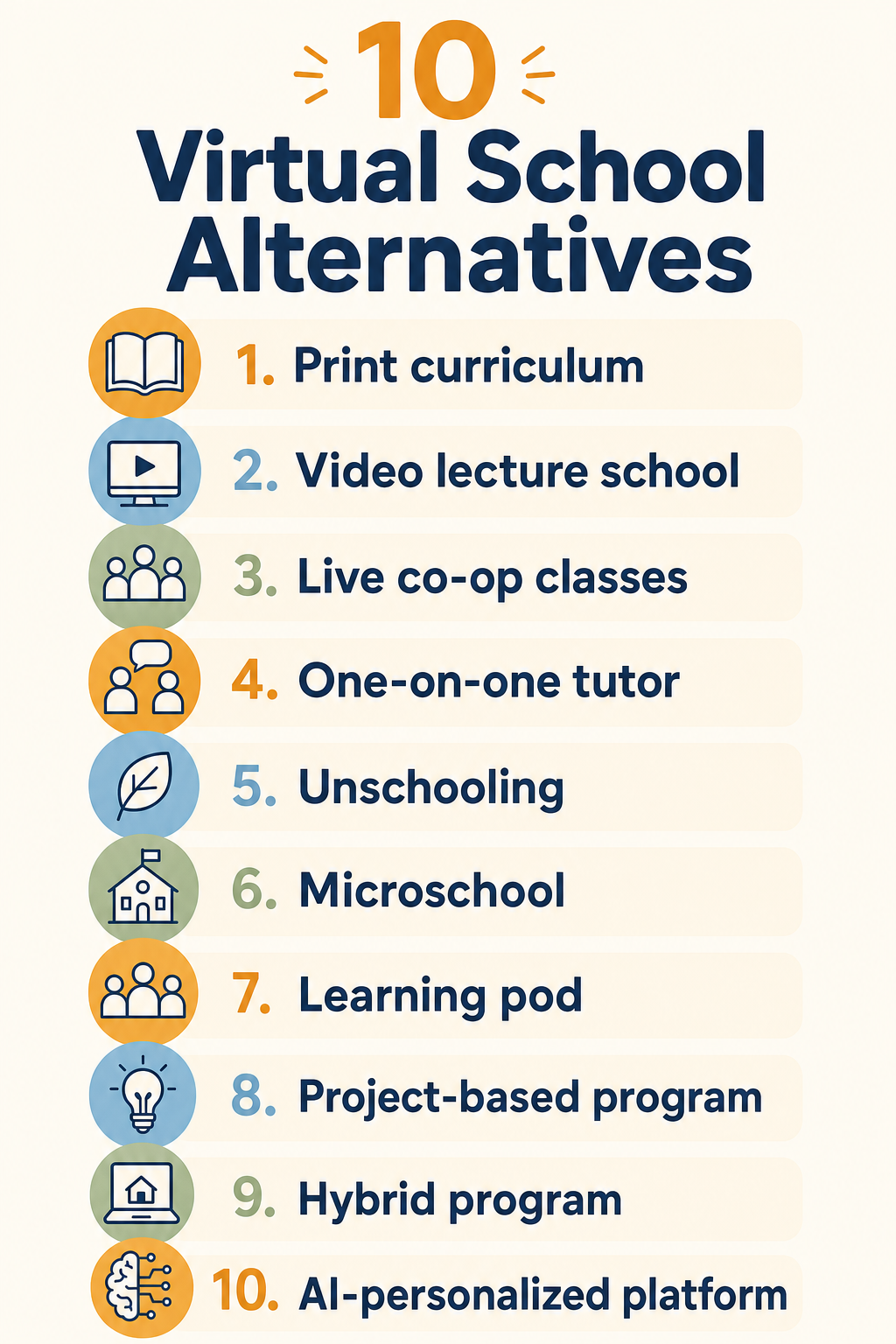
| # | Approach | Who teaches | Best fit for |
|---|---|---|---|
| 1 | Workbook or print curriculum | You, mostly | Full control and low cost |
| 2 | Video-lecture virtual school | A recorded teacher | Kids who do fine with a fixed schedule |
| 3 | Live online co-op | A rotating parent or hired teacher | Kids who need real-time social contact |
| 4 | One-on-one human tutor | A hired tutor | A specific subject gap, short term |
| 5 | Unschooling | The child's own curiosity | Highly self-directed kids |
| 6 | Microschool | A small school's own teacher | Kids who want a school-like setting, smaller |
| 7 | Learning pod | A shared tutor across a few families | Splitting cost and teaching load with others |
| 8 | Project-based online program | A facilitator, loosely | Kids who need to build, not just read |
| 9 | Hybrid homeschool program | A mix of in-person staff and you | Kids who need some in-person days, not five |
| 10 | AI-personalized platform | An adaptive AI teacher, matched to the kid | Kids who need real pacing and tone changes |
1. Workbook or print curriculum
The original homeschool approach, and still the most common starting point. You buy a boxed or printed curriculum, set the pace, and teach directly from the book. It costs the least of anything on this list and gives you full control over what your kid sees each day. A typical morning looks like this: you open the teacher's guide, work through the day's lesson together at the kitchen table, and grade the practice pages yourself before moving on.
The tradeoff is that you are the entire teaching staff. Every explanation, every grading pass, every stuck moment is yours to handle, and the curriculum itself cannot adjust when the printed page is not landing. There is no built-in way to know a concept from three weeks ago never actually stuck until it shows up wrong on a test.
- Good fit if: you have the time most weekday mornings, you are comfortable with the subject matter yourself, and your kid does fine with a page-based format.
- Probably not a fit if: you are managing more than one grade level at once, working outside the home, or teaching a subject you never felt confident in yourself.
- What it costs: typically the cheapest option on this list, often a few hundred dollars a year per kid for materials.
2. Video-lecture virtual school
A recorded teacher delivers the same lesson to every enrolled student on a fixed calendar, the closest thing to a classroom without the room. It solves the accreditation and structure question fast, which is why it is often a family's first stop after leaving a traditional school. Log in at a set time, watch the lecture, complete the linked assignment, submit it, repeat the next day.
The limitation is real, though. A kid who needs to pause and ask a question, move faster through material they already know, or hear the explanation phrased a different way gets none of that from a recording. Some kids do fine here, especially ones who read well and can sit through a set class time. The problem shows up for the kids who tune out by minute six and come away having watched the whole thing without absorbing much of it.
| Signal | What it means |
|---|---|
| Reads and listens well, likes a fixed schedule | Strong fit |
| Asks a lot of questions mid-lesson | Weak fit, no way to pause and ask |
| Needs to move faster or slower than the class | Weak fit, pace is fixed for everyone |
| Cost | State-funded virtual academies run free, private programs run into the thousands a year |
3. Live online co-op classes
A small group of homeschool kids meets on video with a live teacher, either a rotating parent or someone hired specifically to run the class. Unlike a recorded lecture, the teacher can answer a question in real time and the other kids on screen give your child actual peer contact. Most co-ops run a single subject on a weekly schedule, so a family typically stitches several together, one for science, one for a foreign language, one for writing, alongside a core curriculum at home.
This fills the social gap a solo curriculum leaves open, and it works especially well for a single subject a parent does not want to teach directly, like a foreign language or a lab science. The tradeoff is a fixed weekly time slot and a group pace, so it moves at the class's speed rather than your kid's. A family running a science co-op on Tuesdays and a Spanish co-op on Thursdays, with math and reading handled at home the rest of the week, is a common shape this takes in practice. Cost usually lands well under private school tuition, charged per class per semester rather than as a lump annual bill.
4. One-on-one human tutor
A hired tutor works directly with your kid, usually for one specific subject and a set number of hours a week. This is the most individually responsive option on the list, since a real person can adjust explanation, pace, and tone in the moment based on what they see your kid struggling with. A typical arrangement is one or two sessions a week, an hour each, focused on a single subject where your kid is stuck.
It is also usually the most expensive per hour of instruction, and most families cannot afford enough tutoring hours to cover an entire curriculum this way. It tends to work best as a targeted fix for one subject gap rather than a full-time teaching solution.
The one-line test: if you can name the exact subject and exact concept your kid is stuck on, a tutor is a strong, fast fix. If you are trying to cover a full course load, the hourly cost stops making sense fast.
5. Unschooling
Instead of a set curriculum, your kid's own curiosity drives what gets learned and when. A question about how engines work turns into a physics unit. A love of a specific book series turns into a writing project. The philosophy trusts that real learning follows real interest, and a parent's role shifts from teacher to resource-finder, someone who notices a spark and hands over the right book, video, or project before it fades.
This approach asks the most of a parent's comfort with ambiguity, since there is no fixed scope and sequence to fall back on. It tends to work best for a highly self-directed kid who already asks a lot of questions on their own, and less well for a kid who needs more external structure to get started.
- Good fit if: your kid is naturally curious and self-driven, and you are comfortable without a fixed daily lesson plan.
- Probably not a fit if: your state requires documented, standards-aligned instruction, or your kid needs structure to engage at all.
- What it costs: close to nothing in materials, but demands real time and attention from a parent to keep noticing and feeding interests.

6. Microschool
A microschool is a small, alternative school, usually a handful to a few dozen kids, run by its own teacher or small staff in a physical or hybrid space. It looks and feels more like a tiny school than solo homeschooling, with a set schedule and other kids in the room every day. Some run five days a week like a traditional school in miniature, others meet two or three days and blend with at-home work the rest of the time.
This solves the in-person social piece more completely than almost anything else on this list, since your kid is genuinely part of a small community, not just checking in for one class. The tradeoff is usually cost per family and a fixed location and schedule you are opting into, closer to a private school decision than a homeschool one. This is really the choice between two different lifestyles, not two curricula: one keeps your family's schedule fully in your hands, the other trades some of that control for a daily building, a staff, and a peer group that shows up whether or not you drove them there. Families who choose it are usually choosing the community and structure first, the academics second.
7. Learning pod
A handful of families team up and share a hired tutor or teacher across their kids, often rotating whose home hosts the group. It splits both the cost and the teaching load that a single family would otherwise carry alone, while still giving kids real, in-person peers. A typical pod runs three to six kids across a couple of grade levels, meeting several days a week in a rotating home or a shared rented space.
Pods take real coordination between households, schedules, and expectations about what gets taught, which is the main friction point. Disagreements over curriculum, discipline, or pace among the parent group are the most common reason a pod dissolves. When it works, it is one of the more efficient ways to combine in-person structure with a manageable price, since the tutor's cost is divided across several kids instead of paid by one family alone.
- Good fit if: you know a few other families with compatible values and schedules who want to share the load.
- Probably not a fit if: you do not have a ready group of families, or you would rather not manage shared logistics and group decisions.
- What it costs: the shared tutor or teacher's cost, split across families, usually landing well below solo tutoring per family.
8. Project-based online program
Instead of lessons and quizzes, your kid works through hands-on projects, building something, researching something, presenting something, loosely guided by a facilitator rather than taught directly. It suits a kid who checks out on passive reading but comes alive when there is something to build. A unit might run several weeks, ending in something tangible: a working model, a written report, a short presentation to the group.
The tradeoff is coverage. Project-based programs are strong at engagement and weaker at guaranteeing a kid has hit every standard skill in order, so many families pair this with a more structured core subject like math running alongside it.
| Signal | What it means |
|---|---|
| Disengages from worksheets, lights up building things | Strong fit |
| State requires strict, sequenced standards coverage | Weak fit on its own, pair with a structured core subject |
| Cost | Comparable to a mid-range online curriculum, varies by provider |
9. Hybrid homeschool program
A hybrid program has your kid attend an actual building two or three days a week, with the rest of the week done at home under your instruction. It splits the difference between full-time private school and full-time solo homeschooling, giving structure and peers part time without the full five-day commitment. In-person days often cover the subjects hardest to teach at home, science labs, group discussion classes, while home days handle math and independent reading.
This fits families who want real in-person days without giving up the flexibility that made them consider homeschooling in the first place. The at-home days still need real content and oversight, so it is not a fully hands-off option, just a partial one.
The one-line test: if the appeal of homeschooling was flexibility, not a full break from a building and a bell schedule, a hybrid program often gets you most of that flexibility while still handing off the two or three days you would rather not teach yourself.
10. AI-personalized learning platform
Instead of one recorded video for every student, the platform reads a profile you write about your specific kid, from their learning style down to what motivates them, and builds each lesson's pace, teaching persona, and even feedback tone to match. Two kids on the same subject can end up with two genuinely different lessons, one paced faster with a calm, literal voice, the other slower with an energetic, story-driven one, without either parent lifting a finger to make it happen.
That is the piece most of the other nine options cannot offer. A workbook cannot change its own reading level mid-page. A recorded video cannot notice your child is bored and switch its approach. A human tutor can adapt, but usually only within an hour or two a week, at a price that adds up fast. We wrote up how six different AI teacher personas get matched to a kid if you want the mechanics behind how that pairing works.
- Good fit if: your kid needs real pacing and tone changes to learn well, or you are managing more than one kid with very different needs on one login.
- Probably not a fit if: your kid's biggest gap is purely social contact, since a platform solves personalization, not peer time, on its own.
- What it costs: typically a flat monthly subscription covering unlimited daily lessons across every subject, well below the cost of comparable human tutoring.
What if my kid does not fit neatly into any one of these ten?
Most do not. That is the actual case for building a custom mix instead of picking a single option off this list. A kid with ADHD, an uneven set of strengths, or a strong pull toward one interest usually needs pieces from several approaches at once. Not just the one that happened to come up first in a search.
This is where a platform that captures the specific human you are raising earns its keep. Special considerations, pacing needs, interests, the wording a correction should use, all of that feeds into how each lesson gets built, so the approach bends to your kid instead of asking your kid to bend to it. We go deeper on ten specific approaches that work for a kid with ADHD, including which signs point to which approach.
Which virtual school alternatives fit a kid who needs more structure or more freedom?
Watch what happens when a lesson gets hard. A kid who wants to be told exactly what to do next, in order, usually thrives with more structure, a fixed sequence, and predictable pacing, closer to options 1, 2, 6, and 9 on this list. A kid who checks out the moment something feels rigid, but lights up chasing a question they came up with themselves, usually needs the freedom of options 5, 8, or 10.
Neither answer is better. It is information about your specific child, and it should drive which end of this list you lean toward. A kid who needs structure but is drowning in a virtual school's one-size pace does not need less structure, they need the same structure delivered at their own speed.
Is virtual school the same as homeschooling?
Not quite. Virtual school usually means your child is still enrolled in a public or private school program, just attending through a screen on a set schedule. Homeschooling means you hold the legal responsibility for your child's education, which gives you more room to choose or combine any of the approaches on this list.
What is the difference between an AI-personalized platform and a virtual school?
A virtual school delivers the same recorded lesson to every enrolled student on a fixed calendar. An AI-personalized platform builds each lesson around your specific child, adjusting pace, teaching style, and even the teacher's tone to how that one kid learns best.
Can I combine more than one of these approaches?
Yes, and most families end up doing exactly that. A common combination is an AI-personalized core curriculum for math and reading, paired with a co-op or microschool pod for the social piece and hands-on projects.
The real takeaway, and where to start
Virtual school is one option on a much longer list. It is not the default you are stuck with once you leave the classroom. The right pick depends on how your kid learns, how much structure they need, and how much teaching you want to do yourself. Not on which option is most familiar or most heavily advertised.
Start by naming what a video lecture could not give your kid, whether that was pace, tone, or real attention. Then look for the approach on this list that fills exactly that gap. If it turns out to be personalization your child is missing, AI Home Academy's free trial runs on full Max tier from day one. Every teacher persona and every adaptive feature is live while you find out if this is the fit you have been looking for.