The 10 Best Approaches for Homeschooling a Kid With ADHD
Your kid can explain a video game's entire strategy tree from memory but cannot sit through a ten-minute math lesson without bouncing out of the chair three times. That is not defiance. It is not a discipline problem either. That is a brain that runs on interest and momentum instead of a fixed schedule, and once you stop fighting it, homeschooling a child with ADHD gets a lot easier for both of you.
This is personal for me. I built AI Home Academy partly for my own daughter, who has ADHD, a kid whose mind is fast, funny, and allergic to the way most lessons get delivered. What follows are ten approaches that work for a brain like hers, not generic advice that assumes every ADHD kid is the same kid.
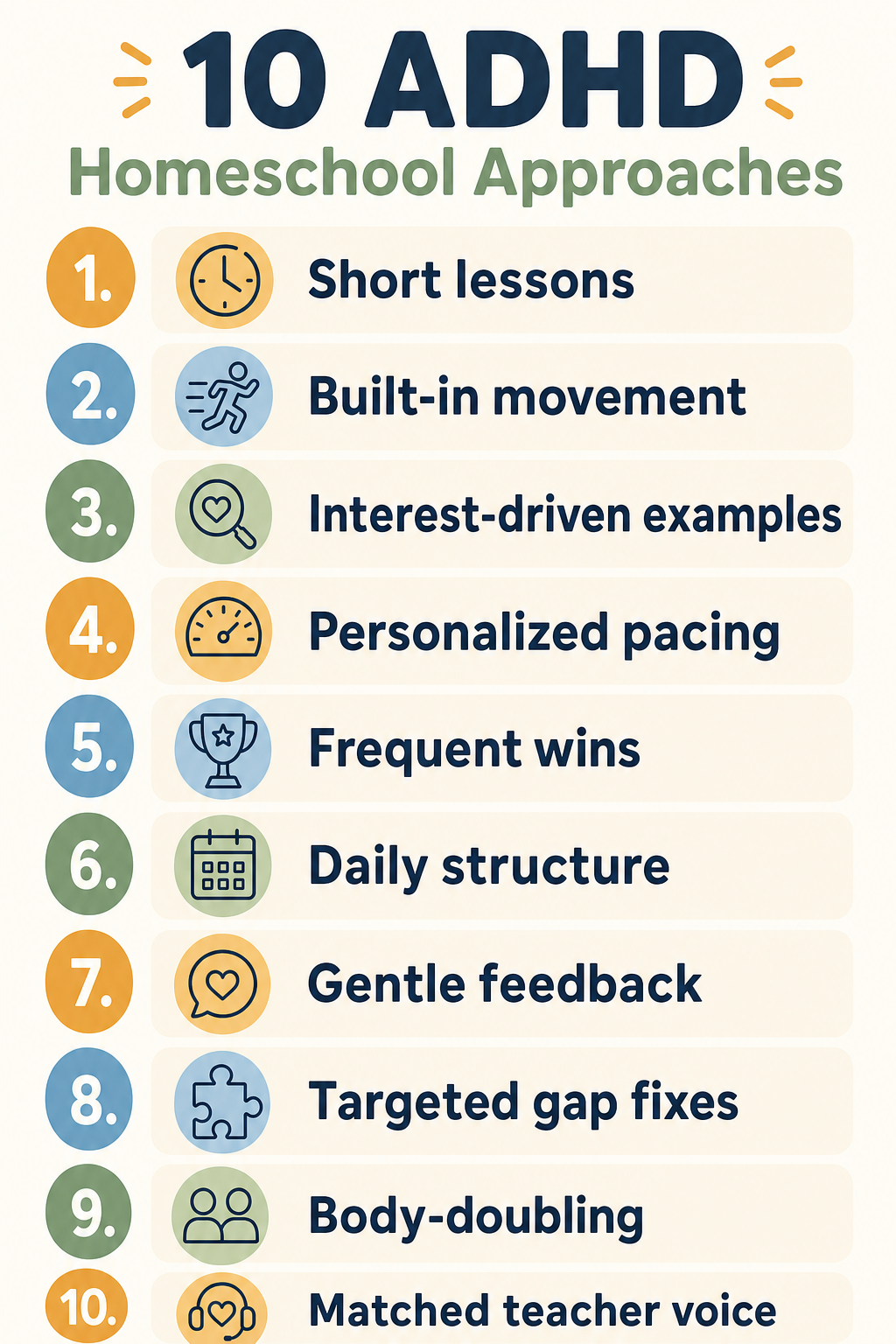
| # | Approach | What it solves | Watch for |
|---|---|---|---|
| 1 | Short, high-momentum lessons | Attention that fades fast | Sessions dragging past ten to fifteen minutes |
| 2 | Movement built into the day | The need to move to think | Expecting stillness for long stretches |
| 3 | Interest-driven examples | Low buy-in on abstract material | Generic examples that feel disconnected |
| 4 | Personalized pacing | Frustration from a fixed schedule | A curriculum that will not slow down or speed up |
| 5 | Visible, frequent wins | Motivation dropping mid-task | Long gaps between any sign of progress |
| 6 | Consistent daily structure | Difficulty with unpredictability | A schedule that changes every day |
| 7 | Gentle, specific feedback | Shutdown after a wrong answer | Blunt correction that reads as criticism |
| 8 | Gap-specific remediation | Missed concepts piling up quietly | Reviewing whole units instead of one skill |
| 9 | Body-doubling or co-working | Trouble starting alone | Assuming independent work will always click |
| 10 | A teacher voice matched to the kid | Mismatch between delivery and personality | One tone used for every learner |
1. Short, high-momentum lessons
Attention for a kid with ADHD often runs on interest and immediacy rather than a clock. A ten or fifteen minute burst that ends before the energy drops keeps the lesson inside the window where the brain is available, instead of stretching past it and losing the last twenty minutes to fidgeting.
The instinct is often to add more time when a kid is behind, on the theory that more minutes means more learning. For this type of brain, that usually backfires. A shorter session done with real focus beats a long one done half-present, and stacking several short bursts across a day usually covers more ground than one marathon block ever would.
- Try this: set a visible timer for ten to fifteen minutes and stop the lesson when it goes off, even mid-problem, then pick back up after a short break.
- Try this: stack three or four short bursts across a morning instead of one long block, with a real break between each.
- Watch for: a lesson that keeps running past its natural stopping point because "we are almost done." That is usually the moment focus has already left the room.
2. Movement built into the day
Movement is not a distraction from the lesson, it is often part of how the information gets processed. A kid who paces while thinking through a problem, or fidgets while listening, is frequently more engaged than one sitting perfectly still, even though the stillness looks more like "paying attention" to an adult watching.
Build movement into the structure instead of fighting it. Standing desks, a stretch between subjects, a walk while reviewing vocabulary out loud, all of these let the body do what it needs to do while the lesson keeps moving. A parent who lets a kid pace laps around the kitchen table while reciting spelling words out loud is often getting a better result than the same kid pinned to a chair, even though the pacing looks like the opposite of focus. Fighting for stillness usually costs more focus than it buys, and correcting a fidget as if it were misbehavior tends to backfire, since it is very often the thing keeping the lesson on track, not derailing it.
3. Interest-driven examples
Motivation for these kids tends to be built moment to moment, not sustained by a distant reward. Material that connects to something they already care about gets in a lot faster than material that does not. A fraction lesson framed around a kid's favorite sport lands differently than the same lesson with generic numbers.
This is where a platform that knows your kid's interests earns its keep, since the same math can be delivered a dozen different ways depending on what a specific child is into. We cover how that profile gets built and used in how the platform adapts to your child's learning style, including what information feeds the lesson.
- Try this: before a new unit, ask what your kid is currently obsessed with, a game, a sport, a show, and see if you can reframe even one example around it.
- Try this: let a current interest set the topic for a writing or research assignment instead of assigning a generic prompt.
- Watch for: curriculum that uses the same three generic examples for every kid. That is a sign the material was not built to bend to any one interest.

4. Personalized pacing
A fixed pace assumes every kid needs the same amount of time on every concept, and that assumption breaks fast for a brain that races through some material and stalls hard on other parts. A workbook cannot slow down for the concept your kid is stuck on or speed up through the one they already have.
Pacing set per subject, not per grade level, solves this directly. A kid can move quickly through reading while taking real time on multiplication, without either subject being held hostage to the other's pace. That flexibility matters more for ADHD kids than almost any other single factor, since a mismatched pace is often what turns a manageable lesson into a meltdown.
| Situation | What fixed pacing does | What personalized pacing does |
|---|---|---|
| Kid already knows the concept | Forces review pages anyway | Lets them test out and move on |
| Kid is genuinely stuck | Moves on regardless, on schedule | Slows down until it lands |
| Two subjects, two speeds | Assumes both take the same time | Tracks each subject on its own clock |
5. Visible, frequent wins
A brain that runs on momentum needs proof of progress often, not just at the end of a unit weeks later. Small, visible markers, a completed lesson, a streak, a concept moving from shaky to solid, give a kid something concrete to feel good about right now. That matters more for this population than for a kid who can coast on a distant reward.
Long gaps between any sign of progress are where motivation quietly drains out. A kid can be doing perfectly fine work and still lose steam if nothing ever confirms that the work is landing. Frequent, honest markers of progress keep the loop closed often enough for momentum to build.
The one-line test: if your kid cannot tell you, in the moment, whether they are doing well right now, the feedback loop is too slow for this brain. A streak count, a sticker chart, or a specific callout said out loud all close that loop faster than waiting for a unit test to hand down the verdict weeks later.
6. Consistent daily structure
A predictable shape to the day, roughly the same subjects in roughly the same order, gives a kid with ADHD one less thing to manage. Unpredictability is its own tax on attention, since part of the brain is always tracking what comes next instead of focusing on what is in front of it.
Consistency does not mean rigidity. The specific minute-by-minute schedule can flex, but the overall shape, morning subjects, a real break, afternoon subjects, holding steady day to day removes a layer of friction that a constantly shifting routine adds back in.
- Try this: post a simple picture or word schedule of the day's shape somewhere your kid can check it without asking you.
- Try this: keep the order of subjects the same even on lighter days, so the sequence itself becomes automatic.
- Watch for: a week where every day looks different. That variability alone can eat up attention before the actual lesson even starts.
7. Gentle, specific feedback
Correction should sound like naming exactly what to try next, without any language that reads as blame or frustration. A kid who already struggles with shutdown after a wrong answer needs feedback that stays specific and forward-looking. Something closer to "try regrouping the tens here" than a flat "wrong, try again."
Feedback wording is not a small detail for this population. A correction that lands wrong can end a whole session's momentum in one sentence, while the same information delivered gently keeps a kid moving. Two ways of saying the exact same thing show how much this matters: "you forgot to carry the one, wrong answer" versus "try carrying the one here." Same math, same correction, and one of them keeps a kid trying while the other one shuts a session down. This is one of the profile fields that shapes how a lesson responds when your kid misses a question, and it is worth asking your kid directly how they want to hear a correction, then actually using their answer, rather than guessing.
8. Gap-specific remediation
Catch missed concepts early and by name, rather than reviewing a whole unit and hoping the gap surfaces. ADHD kids are especially prone to a distracted morning turning into a half-heard concept that quietly becomes a hole in the foundation, since attention naturally drifts more than it does for other learners.
A system that reads actual graded answers and names the specific concept that slipped, rather than flagging an entire topic as weak, respects the time and effort a kid with ADHD is already spending. We wrote up how gap detection and remediation works in the Study Corner, a Max AI plan feature, if you want the mechanics behind catching these gaps before they grow.
| The default reaction | The targeted reaction |
|---|---|
| "Review the whole chapter" | Name the one concept that actually slipped |
| Assume a wrong answer means confusion | Ask your kid to explain their thinking first |
| Track "math is weak" broadly | Keep a running list of the exact concepts that slipped |
9. Body-doubling or co-working
Working alongside another person, even one doing something unrelated, helps some ADHD brains start and sustain a task that would stall out done completely alone. This is a well-known strategy outside of school too, and it applies just as directly to a homeschool lesson.
That can mean a parent sitting nearby doing their own work, a sibling working at the same table, or a scheduled check-in that breaks isolation without requiring direct teaching. Do not assume independent work will always click just because a kid is capable of the material. Sometimes the missing ingredient is not being alone with the task.
The one-line test: if your kid is fully capable of the material but cannot seem to start it alone, that is a starting problem, not a knowledge problem, and the fix is presence, not more instruction. Try a shared timer, "we both work until this goes off," so the presence itself carries the task forward.
10. A teacher voice matched to the kid
A kid who runs on momentum tends to respond to an energetic, story-driven teaching style, while a sibling who needs predictable, literal structure does better with a calm, step-by-step voice. Same subject, two different deliveries, and mismatching the two is often what makes an otherwise fine lesson feel wrong for a specific kid.
AI Home Academy matches each learner to one of six teaching personas based on exactly this type of profile, so an ADHD kid gets paired with a persona built for energy and momentum while a sibling gets someone steadier. The full breakdown of how each of the six personas gets matched to a kid covers which traits point to which teacher.
- Try this: notice whether your kid responds better to an energetic, story-driven explanation or a calm, literal, step-by-step one, and lean into that voice deliberately.
- Try this: if you have more than one kid, do not assume the same explanation style works for both, even on the exact same material.
- Watch for: a single teaching voice applied to every kid in the house. What reads as "clear" to one can read as flat or overwhelming to another.
Is homeschooling a kid with ADHD easier than a classroom?
Often, yes, mainly because homeschooling removes the fixed pace and one-size structure of a classroom of twenty-five kids. The gain comes from being able to match pacing, movement, and teaching style to that specific child, not from homeschooling itself being a cure.
How long should a homeschool lesson be for a kid with ADHD?
Shorter than you probably think, often ten to fifteen minutes of focused work followed by a real break, rather than one long block. Short bursts with momentum tend to outperform a single stretched-out session for a brain that runs on short-term interest.
Does a kid with ADHD need a diagnosis before I change my approach?
No. You can adjust pacing, movement, and teaching style based on what you observe, whether or not a formal diagnosis exists yet. A diagnosis can help with documentation and access to certain supports, but it is not a prerequisite for teaching your kid the way they learn.
The real takeaway, and where to start
Ten approaches, one common thread. An ADHD brain needs the lesson to bend to its pace, its energy, and its interests, not the other way around, and every approach on this list is one version of that same idea. None of them require a formal diagnosis first, just honest attention to what your specific kid needs.
Start by writing down which two or three of these ten your kid needs most right now, whether that is shorter sessions, gentler feedback, or a teaching voice with more energy. AI Home Academy's free trial runs on full Max tier from day one. Every persona, the Study Corner, and the pacing controls are all live while you find out if this is the fit your kid has been missing.