10 Things That Actually Matter When You're Choosing an AI Tutor for Homeschool Kids
10 Things That Matter When You're Choosing an AI Tutor for Homeschool Kids
Your kid asks the same chatbot the same math question three days in a row, and it explains it the same generic way each time, with zero memory that yesterday's explanation did not land. That is not tutoring. That is a search engine wearing a friendly voice, and it is worth knowing the difference before you pick an AI tutor for homeschool kids.
Not every tool that calls itself an AI tutor is tutoring. Some are genuinely built to adapt to your kid over time. Others are a chat window bolted onto a curriculum, answering whatever gets typed in with no memory of the conversation before it. Here are ten things worth checking, ranked by how much they separate a real tutor from a chatbot wearing the label.
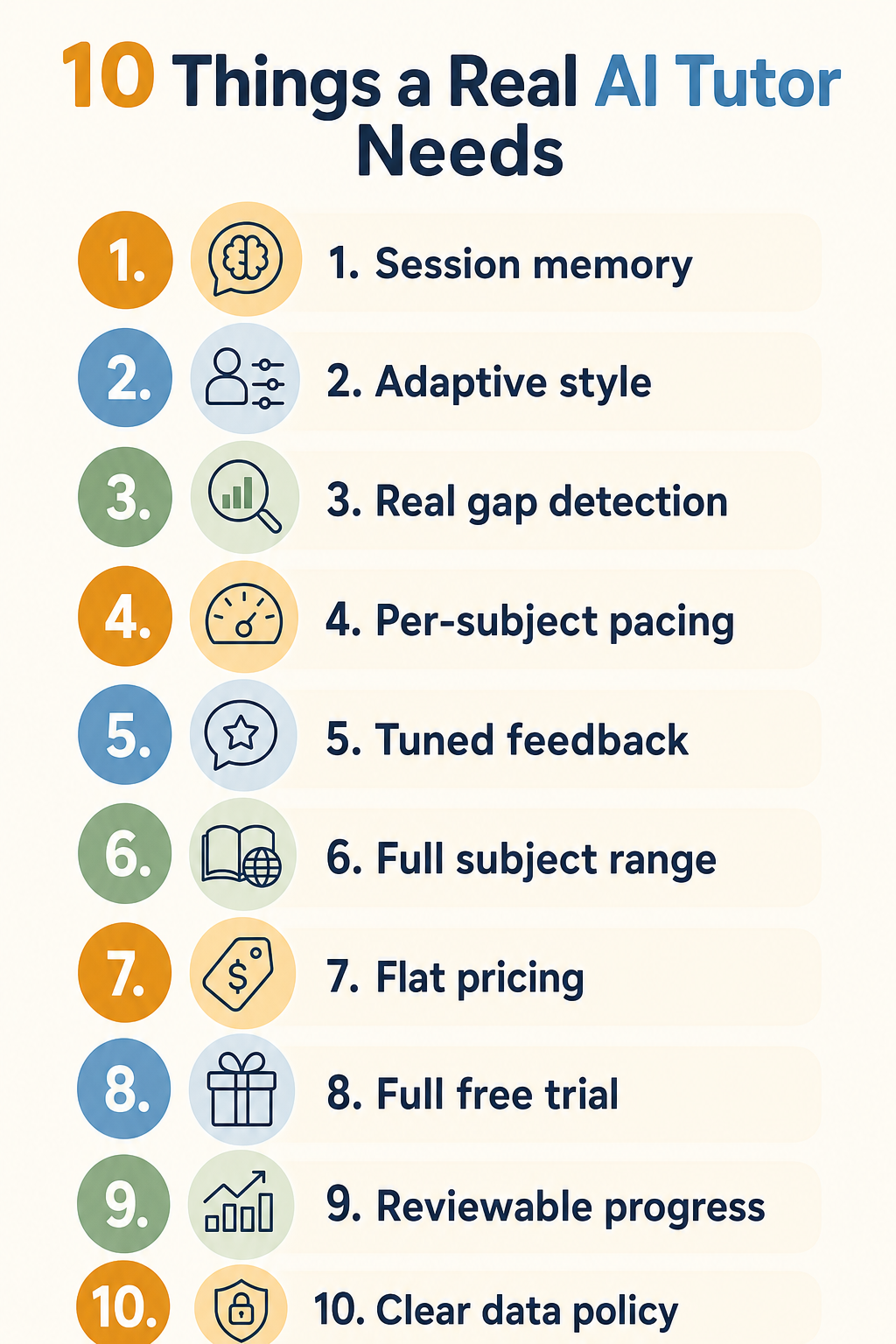
| # | What to check | Chatbot with a homework skin | Real AI tutor |
|---|---|---|---|
| 1 | Memory across sessions | None, each question is isolated | Tracks what your kid has learned over time |
| 2 | Teaching style | One generic tone for everyone | Matched to your kid's actual personality |
| 3 | Gap detection | Answers what is asked, nothing more | Finds the concept underneath a repeated mistake |
| 4 | Pacing | Fixed, same speed for every learner | Adjusts per subject, per kid |
| 5 | Feedback wording | Same phrasing for every wrong answer | Adjusted to how your kid takes correction |
| 6 | Subject breadth | Homework help on demand, one subject at a time | A full curriculum across every subject |
| 7 | Pricing | Billed like human tutoring, per session | One predictable monthly price |
| 8 | Trial access | A stripped demo | Full feature set, live from day one |
| 9 | Progress reporting | Nothing a parent can review | Real, reviewable records of what was learned |
| 10 | Data handling | Unclear what happens to your kid's information | Clear answers about storage and privacy |
1. Memory across sessions
Learning is not a single conversation, it is a long series of moments that build on each other, and a tool with no memory of session one cannot possibly build toward session ten. A kid who struggled with a concept last Tuesday needs a tutor that remembers that struggle on Thursday, not one starting from zero every time.
This is the single biggest gap between a real tutor and a chat window. We wrote up how the memory system works and what it carries forward between lessons, including the specific pieces of information that feed into every future lesson your kid opens.
- How to test it in a trial: have your kid struggle with a concept on day one, then ask about a related problem on day three. A real tutor should reference the earlier struggle without being told.
- Red flag: the tool re-introduces itself or re-explains basics your kid already covered, as if session one never happened.
2. Teaching style that adapts
A basic chatbot might vary its wording, but the underlying delivery, the tone, the pacing, the framing, stays identical no matter who is asking. A real AI tutor changes its entire teaching persona based on the specific kid in front of it.
An energetic, momentum-driven kid needs a completely different voice than one who needs calm, literal, step-by-step instruction, and a tool that only has one setting cannot serve both. The clean test is to set up two learner profiles with opposite traits, one energetic, one needing calm structure, and compare how differently the actual lessons read back. If both profiles come back sounding like the same assistant with a different name typed in, the personas are decorative, not real. How six different teaching personas get matched to a kid covers exactly what genuine variation should look like in practice.
3. Real gap detection, not single-answer reaction
A real tutor can tell the difference between a gap and a bad day, because it tracks patterns across many answers instead of judging a single response in isolation. A kid who misses one problem on an otherwise strong day is different from a kid who has made the same category of error five times across two weeks. Only a system paying attention over time can tell those apart.
A tool that treats every wrong answer the same, offering the identical hint regardless of context, is not diagnosing anything. It is just reacting. Our breakdown of how gap detection works shows what real pattern recognition looks like versus a single wrong-answer response.
- How to test it in a trial: miss the same type of problem several times across different sessions and see whether the tool ever names the specific pattern, rather than just offering a new hint each time.
- Red flag: the exact same generic hint appears after every wrong answer, no matter how many times the same mistake repeats.

4. Pacing that adjusts per subject
Real personalization means pacing set per subject and per kid, not a fixed sequence everyone moves through at the same rate. A tool that cannot slow down for a hard concept or speed up through material your kid already knows is not personalizing anything, no matter how it markets itself.
Test this directly during a trial by handing your kid a subject they are advanced in and a subject they are behind in, on the same day.
| What you hand the tool | A tool that is not really personalizing | A tool that is |
|---|---|---|
| A concept your kid already knows | Grinds through it anyway, at the standard pace | Notices and moves on quickly |
| A genuinely hard concept | Repeats the same explanation, just louder | Slows down and tries a different angle |
| Two subjects, two speeds | Moves both at the same fixed rate | Paces each one on its own clock |
5. Feedback wording tuned to the kid
The exact phrasing a tool uses after a wrong answer can determine whether a kid tries again with confidence or shuts down entirely, and this varies enormously by child. A kid who needs a blunt, factual correction can find gentle language frustratingly vague, while a sensitive kid can be derailed by anything that reads as criticism.
A real AI tutor lets you set this, rather than applying one universal tone to every learner. Check whether the platform asks about feedback preference when you set up a profile, or whether every kid gets the same scripted response regardless of what you told it about your kid.
- How to test it in a trial: set a preference for gentle feedback in the profile, then get a question wrong on purpose and read exactly how the correction is worded.
- Red flag: the setup process never actually asks how your kid takes correction, or the wording does not change no matter what you set.
6. Subject breadth beyond homework help
Some tools only step in when your kid pastes in a homework question, one subject, one problem at a time, with no sense of a broader curriculum underneath. A real AI tutor covers a full range of subjects as an actual teaching system, not just an on-demand answer key for whatever is due tomorrow.
This distinction matters for whether the tool can be a homeschool's core instruction or only a supplement to something else you are already running.
The one-line test: try to build out a full week's plan across math, reading, and one more subject. If there is no real course structure to explore, only a chat box waiting for a homework question to be pasted in, the tool is a supplement at best, not a curriculum.
7. Transparent, predictable pricing
A tool priced close to human tutoring rates without offering memory, adaptive pacing, or persona matching is likely charging for the label rather than the actual capability. Well-built AI tutoring should cost meaningfully less than comparable human instruction, since an AI tutor is not billing by the hour the way a person does.
Look for one predictable monthly price covering unlimited use, rather than a structure that quietly scales with how much your kid uses it. A tool that punishes heavy use with extra charges is not built the way an actual full-time tutor should be.
- How to test it in a trial: read the pricing page before you sign up and check whether it lists a single flat price or a maze of usage tiers and add-ons.
- Red flag: the pricing page requires a sales call to get a real number, or usage caps are buried in fine print.
8. A real trial, not a stripped demo
A demo is built to show a tool at its best, not to reveal how it behaves with your child's quirks. A free trial on the platform's full feature set, not a limited preview, is the only real way to know if the memory, pacing, and persona matching hold up with your kid's real questions.
Watch specifically for whether the tool references something your kid struggled with two days earlier, and whether the teaching voice shifts to match what you described in your kid's profile. Those two behaviors alone will tell you more than any feature list on a marketing page.
- How to test it in a trial: ask directly, before signing up, whether the trial includes every feature or a limited subset. A vague answer is itself useful information.
- Red flag: the "free trial" locks the persona matching, memory, or reporting features behind a paid tier, so you never actually see the real product.
9. Progress you can review
A tutor working well should leave behind something a parent can look at, not just a chat log. Real, reviewable records of what a kid has learned, where they are strong, and where they are still shaky give you an actual picture of progress. Not just a vague sense that "lessons are happening."
This matters even more if your state requires homeschool documentation, since a tool with no reporting leaves you reconstructing months of progress from memory. Ask what a parent sees on the other end, a dashboard, a report, anything concrete, before you commit.
- How to test it in a trial: after a few lessons, look for an actual parent dashboard or report and see if it names specific concepts, not just a completion percentage.
- Red flag: the only way to see what your kid did is to scroll back through a raw chat transcript yourself.
10. Clear answers about your kid's data
Any tool that holds a detailed profile of your child, their learning style, their struggles, their interests, is holding real information worth protecting. A platform should be able to tell you plainly what gets stored, how long it is kept, and who can see it.
Vague or evasive answers here are a real warning sign, not a minor detail. Ask directly before you commit any personal information about your kid, and expect a clear, specific answer rather than a general privacy policy link.
- How to test it in a trial: email or message support before you enter real details and ask exactly what happens to your kid's data. A specific, direct answer is a good sign.
- Red flag: the only response is a link to a generic privacy policy with no direct answer to the actual question.
What should you look for in an AI tutor for homeschool kids?
The ten checks above are the real test, not the marketing copy on a tool's homepage. Memory across sessions, persona matching, real pacing, gap detection, and feedback tuned to your specific kid separate a genuine AI tutor for homeschool kids from a chat window with a homework skin.
Is an AI tutor the same thing as a chatbot that answers homework questions?
No. A homework chatbot answers whatever question you type into it, once, with no memory of your kid. A real AI tutor holds a profile of your specific child, tracks what they have learned over time, and adjusts pace and teaching style based on that history.
Can an AI tutor replace a human tutor entirely?
For most homeschool families, yes for day to day instruction, though a human tutor still has a place for a specific, short-term gap. The real question is whether the AI tutor genuinely adapts to your kid or just answers questions on demand, since only the first one does the job a human tutor does.
How much does a good AI tutor cost compared to a human one?
Significantly less over the course of a month, since a human tutor bills by the hour and an AI platform typically does not. A couple of weekly human sessions add up quickly, while a genuinely adaptive AI tutor covers unlimited lessons across every subject for one predictable monthly price.
The real takeaway, and where to start
Most tools calling themselves AI tutors are a chat window with a homework skin, answering questions without any memory or adaptation behind them. The ten things on this list are the actual test, memory across sessions, persona matching, real pacing, gap detection, and feedback tuned to your specific kid, ahead of anything about branding or marketing copy.
Run a real trial before deciding, and watch for whether the tool remembers your kid from one day to the next. AI Home Academy's free trial runs on full Max tier from day one. Every persona, the full memory system, and the Study Corner are all live while you check each of these ten things against your kid's actual questions.