10 Things to Know Before You Pull Your Kid Out of School
You are standing in the school pickup line again, and your kid gets in the car quiet, that particular quiet that means something happened today they are not ready to talk about yet. Bullying, a teacher who does not get how their brain works, a diagnosis nobody at school seems to know what to do with, whatever the reason, you have started thinking seriously about whether to pull your kid out of school. That thought is not reckless. It is the beginning of a decision worth making carefully, not the whole decision itself.
Why do kids hate school in the first place?
Usually not the subjects themselves. A kid who dreads school is more often reacting to a mismatch, the pace, the social pressure, an undiagnosed learning difference, a teaching style that never fit them, than to learning itself. Naming the real reason, instead of assuming your kid is just being difficult, is the first honest step toward a real decision.
No one hands you a checklist when this thought first shows up. Here are ten real things worth knowing before you make the call, in roughly the order most families need them, so the decision is informed instead of just urgent.
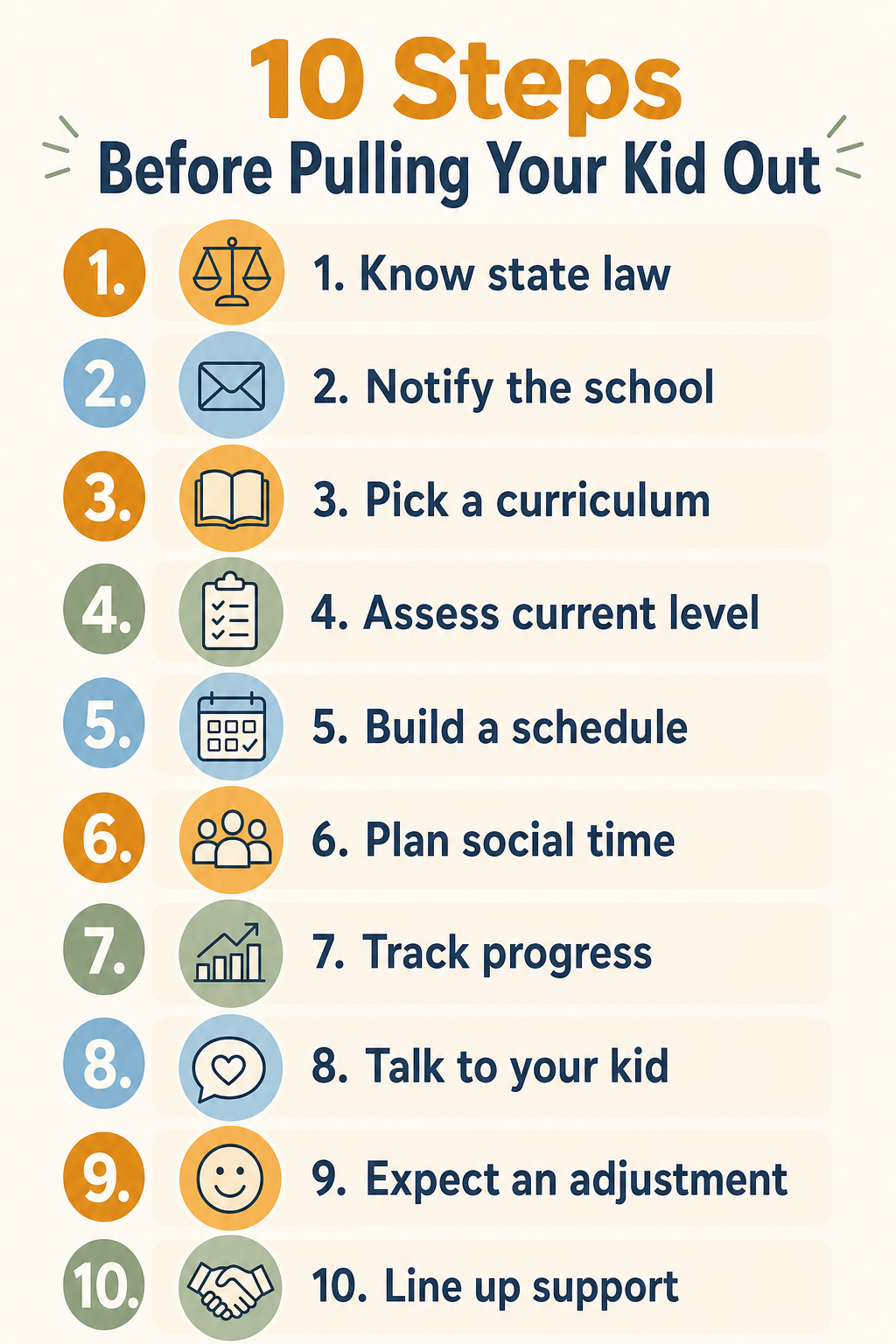
| # | Step | Why it matters |
|---|---|---|
| 1 | Check your state's homeschool law | Determines notice requirements, testing, and recordkeeping |
| 2 | Notify the current school in writing | Formally ends enrollment on your terms and timeline |
| 3 | Decide on a curriculum or platform approach | Sets the shape of your kid's actual day |
| 4 | Assess where your kid currently stands | Prevents guessing at the right starting point |
| 5 | Set up a simple daily structure | Gives predictability without copying a school schedule |
| 6 | Plan for social contact outside the house | Addresses the most common outside worry directly |
| 7 | Set up progress tracking from day one | Builds documentation as you go, not in a scramble later |
| 8 | Talk to your kid about the change | Reduces anxiety about what is happening |
| 9 | Give yourself a real adjustment window | Normalizes a rocky first few weeks |
| 10 | Know what support exists if it gets hard | Prevents isolation from becoming the actual problem |
1. Check your state's homeschool law
Your state's homeschooling requirements vary widely and determine every next step you take. Some states require only a simple notice of intent to homeschool. Others require specific subjects, periodic assessments, or portfolio review. Knowing your state's actual rule set turns an overwhelming decision into a short, concrete checklist.
This step matters more than it might seem, because uncertainty about legality is one of the biggest quiet fears new homeschool parents carry. Once you know exactly what your state requires, most of that anxiety resolves into a handful of forms and dates, not an open-ended legal risk.
- Do this: search "[your state] homeschool requirements" and look specifically for notice deadlines, required subjects, and any testing or portfolio review.
- Real scenario: a family in a low-regulation state might need nothing more than a one-time notice letter, while a family in a high-regulation state may need annual standardized testing or a portfolio review. Knowing which one applies before you start changes how you plan the whole year.
2. Notify the current school in writing
Homeschooling is a legal option in every state, and the process is generally a notification, not a request for permission. You do not typically need to explain bullying, a learning difference, or any other reason to a school administrator before withdrawing your child.
A brief, polite written notice tends to make the transition cleaner, closing out enrollment formally rather than leaving it ambiguous. Keep it simple and factual: a short, dated letter or email stating the withdrawal date and that you are beginning homeschooling, with a copy kept for your own records. You are not filing a complaint or asking permission, you are informing the school of a decision you have already made. A parent who calls the front office first and gets conflicting verbal answers from three different staff members almost always finds that a simple written notice, sent and saved, resolves the confusion faster than any phone call ever did.
3. Decide on a curriculum or platform approach
This is the step that shapes everything else about your kid's actual day, and it is worth deciding deliberately rather than defaulting to whatever the first search result suggests. You are not required to personally deliver every lesson in every subject. Many homeschool families rely on a curriculum, a platform, or outside instruction to handle the actual teaching, while the parent manages structure, oversight, and the parts that genuinely benefit from a parent's involvement.
If your kid has ADHD or another learning difference the school never addressed well, this decision matters even more. A classroom built around an average pace and a single teaching style struggles to serve every type of brain in the room, no matter how good the teacher is. That limitation follows into a mismatched curriculum at home just as easily. A platform that can teach a subject you do not know well yourself, including real coding instruction, removes one of the biggest barriers to starting.
- Do this: list the two or three subjects you feel least confident teaching yourself, and prioritize finding a curriculum or platform that covers exactly those first.
- Real scenario: a parent confident in reading and history but shaky on math and science often ends up piecing together a hybrid: teaching the subjects they know directly, and leaning on a platform or outside class for the rest.

4. Assess where your kid currently stands
The fear of falling behind is one of the most common worries new homeschool parents carry. It treats "behind" as a fixed, permanent state rather than a starting point you can identify and work from. A short assessment of where your kid currently stands, subject by subject, replaces guessing with actual information.
From there, instruction that moves at your kid's real pace, rather than a fixed classroom calendar, often closes gaps faster than the classroom setting your kid just left, since the pace and attention are no longer split across twenty-five other students.
| What a school report card says | What a subject-by-subject check often finds |
|---|---|
| "Behind" as one overall label | Solid in most of the subject, one specific gap |
| A single letter grade | Exact concepts that need rebuilding, named specifically |
| A verdict on ability | A starting point to plan from, not a ceiling |
5. Set up a simple daily structure
Start smaller and more flexible than you think you need. New homeschool families often try to recreate a full school day at home, six or seven hours of scheduled subjects, and burn out fast. Most homeschool instruction takes meaningfully less time than a school day, since there is no waiting for twenty-five kids to settle, no passing periods, and no repeated instructions.
Build a simple daily rhythm instead, core subjects in a focused morning block, with room for interests and breaks in the afternoon. You can tighten or loosen the structure once you see how your specific kid responds, rather than locking in a rigid schedule before you have any real data.
- Do this: block out a two to three hour core-subject window for the first two weeks, then adjust based on how your kid actually responds, not on what a full school day used to look like.
- Real scenario: a family that tried to replicate a seven-hour school day at home burned out within two weeks. Cutting to a focused morning block, with the afternoon left open, fixed the exhaustion without losing any real learning time.
6. Plan for social contact outside the house
The social piece is the most common concern people outside your family will raise, and it deserves a real plan rather than being treated as an afterthought. Co-ops, sports leagues, community classes, and friends from the neighborhood or a former school all remain fully available once you homeschool. The structure changes, the access does not disappear.
Many kids who struggled socially in a classroom setting, especially kids with a learning difference or anxiety around peers, gain more genuine social contact once the daily stress of the classroom is removed. They have more energy left for the interactions they choose, rather than the ones a school day forces on them.
The one-line test: pick one recurring social commitment, a co-op, a sport, a community class, before your first homeschool week starts, so the piece everyone outside your family will ask about is never left to chance.
7. Set up progress tracking from day one
Set this up from the start rather than scrambling later, especially if your state requires documentation. A system that tracks what your kid has learned, concept by concept, gives you something far more useful than a single letter grade. It builds a real record as you go, instead of forcing you to reconstruct one months later.
This matters for state compliance in many places, and it matters just as much for your own peace of mind. We wrote up why finished is not the same as understood, and what real progress tracking looks like, which covers what to look for in a tracking system before you commit to one.
- Do this: pick a tracking method, a platform's built-in reporting, a simple spreadsheet, a folder of dated work samples, before your first lesson, not after your state asks for records.
- Real scenario: a parent who waited months to start tracking ended up trying to reconstruct half a year of progress from memory. Starting on day one turns that into a five-minute update after each lesson instead.
8. Talk to your kid about the change
How you explain this shift matters almost as much as the shift itself. A kid pulled out of school without a clear, honest explanation can fill in the blanks with their own worries, wondering if they did something wrong or if this is a punishment rather than a decision made for them.
Keep the conversation simple and forward-looking. Name the real reason in age-appropriate terms, and be specific about what their days will look like: what time they will start, who they will see, what the first subject will be. Have this conversation before the last day of school, not after. A kid told only "you are not going back," with no explanation, will fill that silence with their own fear that they did something wrong, a fear a single honest conversation about the real reason usually clears up completely. A kid who understands why this is happening, and what to expect next, tends to move through the transition with far less anxiety than one left to guess.
9. Give yourself a real adjustment window
The first few weeks of homeschooling rarely look like the settled routine you are aiming for, and that is normal, not a sign anything is going wrong. Both you and your kid are learning a completely new rhythm at the same time, and a rocky start is the expected shape of that adjustment, not a verdict on whether this was the right call.
Give yourself permission to loosen the plan in the early weeks. A schedule that flexes while you both find your footing will hold up far better than one that demands perfection from day one.
- Do this: block out the first two to three weeks as a trial run in your own head, not a final verdict, and expect to adjust the schedule at least once.
- Real scenario: a family that judged their entire decision by a chaotic first week nearly gave up. Give it three real weeks. Most families find their actual rhythm somewhere in that window, not on day one.
10. Know what support exists if it gets hard
Homeschooling does not have to be a solo project, even though it can start to feel that way in a hard week. Local co-ops, online parent communities, and curriculum or platform support teams exist specifically for the moments when you are stuck, whether that is a logistics question or just needing to hear from someone else who has been through the same adjustment.
Knowing where to turn before you need it removes one more source of stress from an already big transition. Isolation, not the homeschooling itself, is usually what turns a hard week into a reason to doubt the whole decision.
- Do this: join one local or online homeschool parent community before you need it, so there is already a place to ask a question on a hard day.
- Real scenario: a parent stuck on a single logistics question, how to log hours, what a co-op actually costs, spent days worrying alone before finding an answer that a five-minute post in a parent group would have solved immediately.
Do you have to give a reason to pull your kid out of school?
In most places, no. Homeschooling requirements vary by state, but the majority require notifying the district and, in some cases, filing a basic intent to homeschool. You are not generally required to justify the decision to the school itself.
Will my kid fall behind if I pull them out mid-year?
Not in any way that cannot be addressed directly. A short assessment of where your kid stands, subject by subject, lets you pick up exactly where they are instead of guessing, and most families see faster, more targeted progress once instruction matches the kid instead of a fixed classroom pace.
What if I am not sure I can teach my kid myself?
You are not required to be the one delivering every lesson. Plenty of homeschool families rely on a curriculum, a platform, or outside instruction for the actual teaching, while the parent manages the structure and oversight. Not knowing the material yourself is not a barrier to starting.
The real takeaway, and where to start
Pulling your kid out of school is a real decision with real logistics, not a leap you take on faith. Every item on this list, from your state's requirements to what a normal day will look like, can be sorted out ahead of time, which turns an overwhelming choice into a manageable, ten-step checklist.
Start with your state's homeschool law, since everything else builds from there, and give yourself permission for the first few weeks to be an adjustment rather than a verdict on whether this was the right call. AI Home Academy's free trial runs on full Max tier from day one, so you can see exactly what a personalized homeschool day looks like before you commit to anything.